


Brazilian President Michel Temer said yesterday he expects some of his ministers to resign after they were implicated in a massive corruption investigation, but said this would not stop his government from approving landmark economic reforms.
Eight of Temer’s ministers were mentioned by executives of engineering group Odebrecht SA in plea bargain testimonies made public last week.
Temer reiterated that he would not fire any of his ministers before they are formally accused by prosecutors, which could take months or even years.
However, he said that the scandal is “embarrassing” and may lead some ministers to step down.
“It is very likely that some ministers will feel uncomfortable and believe that they cannot continue,” Temer said in a radio interview.
The Odebrecht testimonies escalated a crisis that started three years ago with an investigation into kickbacks at the state-run oil company Petrobras and that already contributed to the impeachment of leftist President Dilma Rousseff last year.
The president has sought to keep the scandal from thwarting his efforts to pass pension and labour reforms needed to keep public finances under control in the years ahead.
The reforms are also considered crucial by investors to pull Brazil out of recession.
The government was expected to present its final pension reform draft on Tuesday to Congress, where a third of the senators and dozens of representatives are under investigation.
With many lawmakers fearing their chances of re-election, the government was expected to ease some of the more stringent elements of the proposal, including a new retirement age.
As such, Temer said another pension reform may be needed in 10 or 15 years.
Finance Minister Henrique Meirelles, who has reiterated the need for a tough reform, on Monday said many points of the draft bill were still being discussed.
The government expects to approve the pension reform by July, according to lawmakers that attended a meeting with Temer on Sunday.
The reform plan, submitted last year to Congress, sets a minimum retirement age at 65 for both men and women and requires more years on the job for workers to gain full pension benefits.
Temer has also sought to overhaul the labour code in an attempt to reduce costs to companies.
The lawmaker in charge of drafting that bill presented his suggestions last week to an empty Congress. Brazilian prosecutors are demanding answers after the names of 17 employers profiting from human trafficking disappeared from the country’s “dirty list” which names and shames companies engaged in modern slavery.
Launched in 2003, the publicly available “dirty list” is one of the government’s most effective tools for fighting human trafficking, said Tiago Muniz Cavalcanti, National Coordinator for the Eradication of Slave Labour with Brazil’s Public Prosecutor’s Office (MPT).
Companies or individuals who appear on the list are barred from accessing credit from state banks or other public financial support in a bid to undermine the economic rationale for trafficking workers into modern slavery.
“There are entrenched economic interests that are against the publication of the list,” Cavalcanti told the Thomson Reuters Foundation. “The MPT has requested information on the reasons for the removal of the 17 names.”
Prosecutors still aren’t sure if the removals were due to administrative errors or an attempt to “suppress” information in order to protect businesses benefiting from modern slavery, Cavalcanti said.
This list is maintained by the Ministry of Labour.
Officials from the ministry did not respond to interview requests.
Cavalcanti said it was not clear when prosecutors will find out what happened to the missing names as inter-agency disputes within the Brazilian state are often drawn-out affairs.
“Concealment of information is only of interest to those on the list,” Cavalcanti said.
“To all others, especially good employers, the dirty list is a very important tool,” so they can avoid doing business with companies involved in the modern slave trade, the prosecutor said.
The call for information from prosecutors is part of an ongoing dispute over the “dirty list” within Brazil’s government.
Publication of names onto the list was suspended in 2014 after Brazil’s Federal Supreme Court granted an injunction at the request of the Brazilian Association of Real Estate Developers.
The Labour Ministry began publishing names again last month, following a 2016 decision by the Supreme Court to suspend the previous injunction.
As of April 1, more than 65 employers had been caught by labour inspectors for subjecting workers to conditions akin to slavery, according to the Labour Ministry’s website.
Most of the exploitation happened on farms, with the construction and timber industries also flagged as hot spots for abuse.
More than 50,000 people have been freed from slavery type conditions in Brazil since 1995, according to the UN’s International Labour Organization, that estimates 21mn people globally are trapped in forced labour.
“The dirty list is still under heavy pressure from large employers who appear on the list,” the prosecutor said.
More than 161,000 people in Brazil are living in modern slavery, according to the Global Slavery Index produced by the Australia-based Walk Free Foundation.
“Since it directly affects the image of the exploiter, the list is currently the most feared punishments of employers,” Cavalcanti said.
A US judge yesterday sentenced Brazilian engineering company Odebrecht SA to pay $2.6bn in fines in a massive criminal corruption case, signing off on a plea deal between the company and US, Brazilian and Swiss authorities.
US District Judge Raymond Dearie said at a hearing in Brooklyn federal court that about $93mn will go to the United States, $2.39bn to Brazil and $116mn to Switzerland.
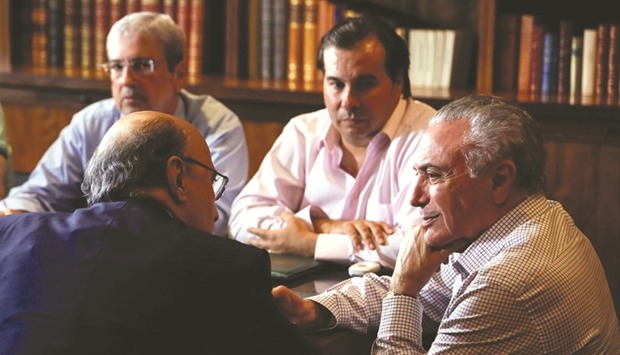
Brazil’s President Michel Temer (R) and Finance Minister Henrique Meireles attend a meeting of the Pension Reform Commission at the Alvorada Palace in Brasilia.