


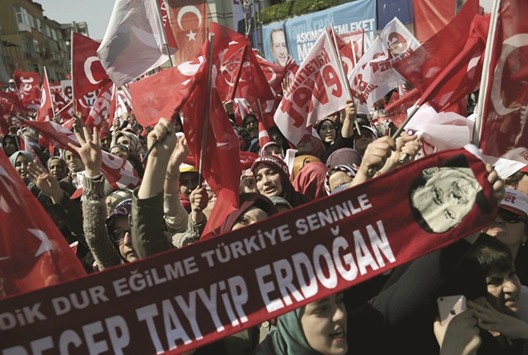
Polls are tight, with the “yes” platform appearing to be ahead and Erdogan himself voicing confidence in a win.
“Think what will happen if, God willing, the ballot boxes burst with ‘yes’ votes,” Erdogan said in his opening speech of the day in Istanbul, the first of four rallies, all broadcast in full on state-run television. “God willing, this nation will have its own feast tomorrow evening.”
The referendum, initiated by Erdogan, asks voters to create a powerful executive presidency, replacing the parliamentary system.
Critics of the proposed constitutional changes say the amendments would erode checks and balances and politicise the judiciary.
The Council of Europe’s Venice Commission said the changes would be a “dangerous step backwards for democracy” by placing too much power in one office.
Erdogan says the move would bring about stability in Turkey, better security and greater economic growth, in addition to being more representative.
Kemal Kilicdaroglu, the head of the main opposition Republican People’s Party (CHP), issued a stark warning on the future of Turkey’s democracy.
“Tomorrow we will make our decision. Do we want a democratic parliamentary system or do we want a one-man regime?” he said in the final hours of campaigning.
Kilicdaroglu is the only major opposition figure to be able to address crowds via state-run and commercial television, even as he only gets a small fraction of the time allotted to Erdogan and the ruling Justice and Development Party (AKP).
Opposition to the referendum has been hobbled by restrictions, according to observers, including the Organisation for Security and Co-operation in Europe (OSCE).
The leftist, pro-Kurdish Peoples’ Democratic Party (HDP) and right-wing nationalist opponents of the proposed changes have been sidelined.
Erdogan often repeats his motto that terrorist groups are backing the “no” campaign.
He also stepped up attacks on Kilicdaroglu, saying that the CHP leader may lose his post after the referendum and alleged that the opposition chief colluded with those blamed of orchestrating last year’s failed coup attempt, a severe accusation made without evidence.
The CHP charges Erdogan of violating campaign laws.
“There definitely was not a fair campaign,” Mehmet Hadimi Yakupoglu, a CHP representative, told DPA.
Erdogan expressed confidence that he would win.
“Some rates show below 55%, some show between 55% and 60%,” he said.
Erdogan also promised that if the referendum passes he would move straight away to bring back the death penalty.
“The decision tomorrow will open the path for this,” he said, indicating another referendum on the issue was possible.
A positive outcome for his camp would a “turning point” in relations with the European Union, Erdogan said, after promising to review relations with the bloc after April 16.
Turkey is an EU candidate country, though European officials increasingly express concerns Ankara is drifting away.
The referendum is taking place during a strict state of emergency enacted after military members carried out a failed coup last year.
Tens of thousands have since been jailed, including dozens of journalists and members of parliament from the opposition who face terrorism charges.
A purge of the civil service is ongoing, including of the judiciary which oversees elections.
Campaigning officially ended at 6pm (1500 GMT) yesterday.
Polls open today at 7am in the east and an hour later in the west, staying open for nine hours.
Results should then come in during the evening hours.
The often polarising campaigning to centralise power has been fraught with tensions, including with Europe.
Turkish ministers were banned from campaigning in key cities abroad, with Erdogan accusing some European leaders of behaving like Nazis.
“This Sunday is the day when our people will give a lesson to those European countries that were involved in all sorts of illegalities to discourage us over the past two months,” Erdogan said in his final campaign address.
Erdogan has been at the helm of Turkey since 2003, first as prime minister and now as president, a role which he assumed in 2014.
The US-based Brookings Institution, a centrist think tank, cautioned that a victory for the pro-Erdogan camp would “accord the president more powers and more independence from the check-and-balance mechanisms than any other Turkish leader since 1946”.
It was in that year that Turkey held its first ever multi-party election.