


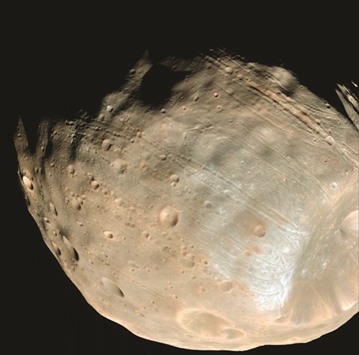
The Martian Moons Exploration project would launch a probe in 2024 destined for Phobos, the largest and closest of two moons circling the Red Planet.
Paris and Tokyo signed a preliminary agreement on Monday, and will make a final decision before the end of the year, CNES president Jean-Yves Le Gall told AFP.
“It’s a very important mission because – besides the Moon – it would be the first time samples from the satellite of a planet would be brought back to Earth,” he said by phone.
Slightly egg-shaped, Phobos is 27km (17 miles) in diameter from end-to-end.
Analysing its composition would solve a long-standing question as to its origins.
One theory holds that the oblong moon is an asteroid captured by the gravitational pull of Mars.
Another says that it is left-over matter from the Red Planet’s creation event.
Landing on Phobos will also provide another vantage point for observing Mars, only 6,000km (3,700 miles) distant.
Getting there poses fewer challenges that landing on Mars, a graveyard for several failed missions.
“It should be twice as easy because the probe will not have to go through the Martian atmosphere,” Le Gall said.
The Japanese partner for the project is the Japan Aerospace Exploration Agency.
Phobos – closer to its planet than any other moon in the solar system – is approaching Mars by about 2m (6.5’) every century.
Scientists expect the moon to be pulled apart in 30mn years.
In 2011, a Phobos-bound probe launched by Russia – its first interplanetary mission in 15 years – failed, with pieces falling into the Pacific two months later.
In 2020, the joint Europe-Russia ExoMars mission will launch a rover tasked with finding traces of Martian life, past or present.
The US National Aeronautics and Space Administration (Nasa)’s Curiosity rover has been criss-crossing the planet for more than three years.