


Abbott Laboratories agreed to consummate its troubled acquisition of Alere in a deal that values the medical test maker’s equity at $5.3bn, shaving $500mn from the original price and ending months of legal manoeuvring that appeared headed for a Delaware court.
Alere shareholders will get $51 a share in cash, according to a statement on Friday. While the new price is an 8.9% cut from the deal announced in February 2016, it’s a 21% jump from the company’s closing price on Thursday. The two parties were slated to meet in Delaware Chancery Court this week to begin hearings on Abbott’s lawsuit to terminate the purchase.
The agreement brings to a close one of the medical- technology industry’s most contentious acquisitions. The deal ran into problems within two months, when Alere received a grand jury subpoena related to its sales practices, and failed to file its financial results with regulators.
After months of public wrangling over the transaction, each company sued the other, with Alere attempting to force the deal to go through and Abbott accusing its target of violating the terms of their agreement.
The renegotiated price was better than many on Wall Street expected, said Jeff Jonas, a portfolio manager at Gabelli & Co Recent decisions in the court case tipped in Alere’s favour and helped them get a better deal, he said. Those included a recommendation that Abbott turn over documents that Alere said proved the company knew what it was getting when it agreed to a deal.
With the legal actions dropped, Abbott must now integrate Alere’s industry-leading point-of-care technology while navigating the company’s raft of US government investigations into bribery and billing practices as well as material weaknesses in its revenue recognition and accounting for income taxes. Alere is also embroiled in a battle with the US Medicare programme over the future of its diabetes products division.
“It’s a great outcome for Alere,” said Raj Denhoy, an analyst at Jefferies. “The Alere collection of point-of-care assets is really the best out there. It has had its issues, but the core of the portfolio and the technologies are still there.”
Both sides welcomed the resolution. Namal Nawana, chief executive officer of Waltham, Massachusetts-based Alere, said in an e-mail that the amended terms “deliver value and certainty to Alere shareholders.” Abbott spokesman Scott Stoffel said the deal is an “equitable settlement.”
The companies expect the transaction to close by the end of third quarter, pending shareholder and regulatory approval.
Abbott Laboratories, based in Abbott Park, Illinois, agreed to buy Alere last year to gain the smaller company’s suite of diagnostic testing devices and products. At the time the two US companies said that the deal would boost Abbott’s diagnostics business to about $7bn in sales after closing.
Less than three months later, Abbott offered $25bn to buy St Jude Medical in the largest acquisition in its history. Investors balked at Abbott’s reach, sending the company’s shares down amid questions about whether it would need to issue shares to pay for both transactions.
“They were overconfident in thinking they could do two big deals at once,” Gabelli’s Jonas said, pointing out that the legal delays may help Abbott digest both companies. “Now they have had St Jude for several months to start getting the integration done. The timing helps them.”
Abbott Chief Executive Officer Miles White bolstered the company’s balance sheet in the interim to help cushion the outlays. The company agreed to sell its medical-optics business to Johnson & Johnson for $4.33bn in September. Just last month it sold 44mn shares of Mylan NV, obtained in exchange for a generic drug business, for $41.60 apiece.
Though lower than the previously agreed bid, the price of $51 a share is more than several earlier offers for Alere, including two $50 a share bids from unidentified companies that came in during negotiations with Abbott and were disclosed in Alere’s proxy filing. The per-share price falls in the middle of Abbott’s original proposed range of $49 to $53 a share, suggested by Abbott’s executive vice president Brian Blaser in December 2015, and below the company’s initial offer of $54 a share a month later.
After trading barbs and legal accusations for the past year, both sides have now pledged to work together. The cost savings from combining the companies could reach $500mn by 2019, Abbott estimated when the deal was first struck.
“It will be interesting to see how they change their tone now that they are moving away from fighting to being one happy family,” Jefferies’ Denhoy said.
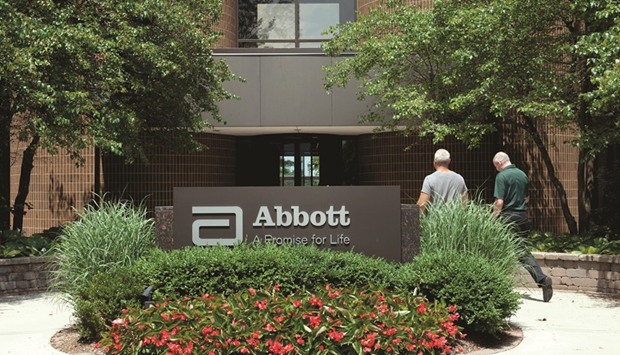
Employees walk near an Abbott Laboratories sign at the company’s headquarters complex in Abbott Park, Illinois. Abbott agreed to consummate its troubled acquisition of Alere in a deal that values the medical test maker’s equity at $5.3bn, shaving $500mn from the original price and ending months of legal manoeuvring that appeared headed for a Delaware court.