


Mass coral bleaching spreading across Australia’s Great Barrier Reef could cost the region 1mn visitors a year, or a loss of A$1bn (US $750mn) in tourism revenue, an independent research organisation said yesterday. The loss of visitors would put 10,000 jobs at risk, the Australia-based Climate Council said in a new report released in Brisbane.
Climate change is pushing up sea surface temperatures and driving extensive and ongoing mass coral bleaching, the organisation said.
“Over the next two to three decades, bleaching events are likely to become even more frequent and severe in Australia, with catastrophic impacts on reef health and the economy,” the report said.
The Unesco World Heritage-listed Great Barrier Reef currently generates A$7bn in income per year and supports 70,000 Australians employed in sectors such as tourism, according to the Climate Council. “This isn’t just an environmental issue.
The Great Barrier Reef is one of Australia’s greatest economic assets,” ecologist Lesley Hughes said in a Climate Council statement.
Last year, the Great Barrier Reef – the largest coral structure on earth – experienced its worst bleaching event in history. Ninety per cent of the reef’s coral in the north was bleached, and more than 20% of the reef’s coral died. In the north, two-thirds of the coral died.
This year, with high water temperatures in the region, mass coral bleaching has occurred again and crippled new areas of the reef.
“Extremely warm water (is) causing particularly severe bleaching now in the middle sections of the reef, which of course is where most of the tourists visit,” Hughes said. “This will have enormous economic and employment consequences for Queensland,” she said.
Coral bleaching is caused by a die-off of the living organisms, or algae, inside the coral. It can be triggered by small changes in environmental conditions, such as a rise in sea temperature or pollution or overfishing. The loss of the colourful algae then causes the coral to turn white.
“The extraordinary devastation being experienced on the Great Barrier Reef is due to the warming of our oceans, driven by the burning of coal, oil and gas,” Hughes said. “It would have been virtually impossible for this to have occurred without climate change,” she said.
Bleaching events worldwide, due to climate change, could put A$1tn at risk, the Climate Council report said, highlighting both economic and ecological challenges.
Coral reefs are the most biodiverse ecosystems on the planet. They are home to at least one quarter of all marine life.
Last month’s devastating Cyclone Debbie brought some cooler water to the area, which could offer some reprieve, but the reef also experienced physical damage due to the extreme weather.
On Monday, the Australian Research Council’s Centre of Excellence for Coral Reef Studies said that only the southern third of the reef had not been affected by consecutive bleaching events in 2016 and 2017.
This year’s bleaching was most intense in the middle, while last year’s was further north, according to aerial surveys of the region. Scientists are worried that the unprecedented back-to-back bleaching will give the coral little chance to recover. They say it usually takes five years for a reef to return to health after a single bleaching event.
The issue means the Great Barrier Reef is in danger of losing the Unesco heritage site status it gained in 1981.
A UN committee is set to give its verdict by July on whether to categorise the region as “in danger.”
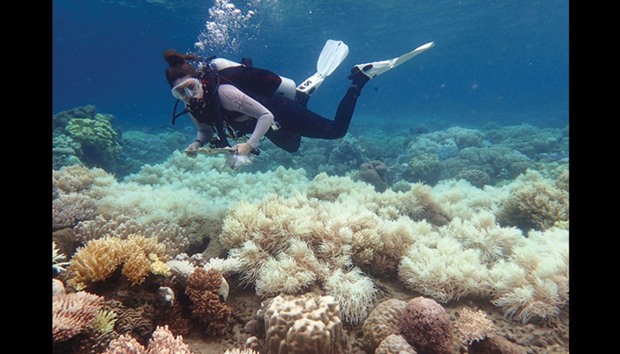
Coral has been bleached for two consecutive years by warming sea temperatures on Australia’s Great Barrier Reef with u201czero prospectu201d of recovery, scientists said, blaming climate change for the large-scale destruction.