


Hungary faced criticism from Washington and Brussels yesterday over a new law that they believe targets a Budapest university founded by US financier George Soros that is viewed as a bastion of independent thinking in eastern Europe.
The top US diplomat in the region said the impact of the legislation on the Central European University (CEU) was a concern, while the European Union’s executive Commission said it would be the subject of a debate today.
Domestic opponents of the new law, which on Sunday triggered some of the largest demonstrations against Prime Minister Viktor Orban’s seven-year rule, consider it part of a wider crackdown on dissent and a political drift towards Russia.
The law requires foreign universities to maintain a campus in their home countries and secure a bilateral agreement between Hungary and their governments.
The CEU, which is accredited in New York state as well as Hungary, has said that both rules were prohibitive as costs would be too steep and Washington had no jurisdiction over it.
“The United States is concerned by this legislation ... because it targets (the CEU) very clearly and threatens ... this important American Hungarian institution,” US State Department Deputy Assistant Secretary for European and Eurasian Affairs, Hoyt Yee, said in Budapest.
Orban has for years criticised Soros, a Hungarian-born Holocaust survivor and philanthropist who has spent billions of dollars campaigning for an open society at odds with the more authoritarian social model that the prime minister favours.
Speaking in Brussels after talks with Commission officials, Hungary’s State Secretary for Education Laszlo Palkovics said his government did not want to close down any university and sought only to protect students against unverified institutions issuing fake diplomas.
The CEU has rejected similar claims by Orban that the university “cheated” with its diplomas.
Grievances between Brussels, some EU capitals and Budapest go beyond the higher education law to issues such as migration and energy policy, as well as moves by Orban to put independent media, NGOs and the judiciary under more state control.
“These are issues that have a certain degree of connection amongst themselves,” the European Commission’s spokesman said yesterday.
Yee told Reuters that, while the new law hurt the university and academic freedoms, Hungary remained a key US ally.
Asked whether it pushed Budapest closer to Moscow, he said the departure of the university would be a loss firstly to Hungarians.
“We are of course ... quite vigilant about what Russia is doing in the region ... in terms of the trend in Hungary, we’re still very close allies ... I expect that is going to continue.”
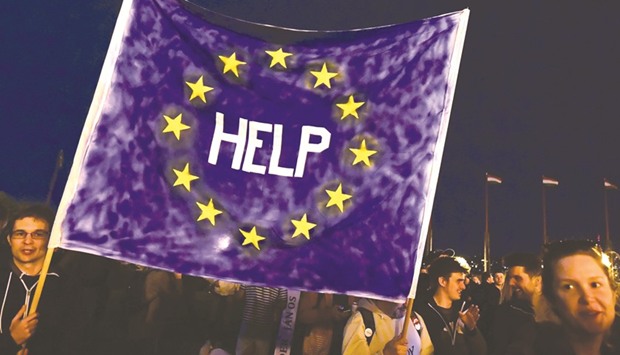
Protesters take part in a demonstration late on Monday against the new higher education legislation outside the Presidential Palace in Buda Castle of Budapest.