


In a recent Jeem Cup match between Qatar and Palestine, a Palestinian player hit the ground hard after receiving an accidental elbow to the head.
To restart the game, Qatar’s young players tried to return the ball to the Palestinian goalkeeper to resume play. However, the goalie failed to hold on to the ball and it sailed into the net. The referee duly declared it a goal, leaving the scoreline at 1-0 in favour of Qatar.
Rather than allow his team to capitalise on this advantage, Qatar and Aspire Academy coach Fouad Elfdil instructed his team to let their opponents score. The Qataris allowed the Palestinian player run through unchallenged and score, levelling the game at 1-1 in a genuine act of fair play rarely seen on the field.
Despite Qatar eventually losing the game 2-1, this unforgettable gesture has come to define the Aspire Academy’s approach to sports development and was captured on video and shared hundreds of times on social media, going viral in North Africa, Germany and other countries around the world.
International media also picked-up on the gesture, shining a light on the young team of Qatari footballers who showed such sportsmanship during the highly-prized Jeem Cup, which features teams of 12-year-old students from 20 countries.
As part of its comprehensive strategy to develop young sporting talents, Aspire Academy has endeavoured to embed the morals of sportsmanship and fair play within its student athletes.
Qatar’s young players did not hesitate when responding to the coach’s call to action, letting their rivals score without even a murmur of discontent, according to international media. Commentators and social media users have also said the players’ actions demonstrated their discipline and that fair play is deeply rooted in their young personalities.
Coach Elfdil said, “It was like a mini World Cup for our young players.”
He described the Jeem Cup as one of his team’s most transformational experiences, given it was the first time many players had worn Qatar’s national team shirt in a competition.
He said of the team’s performance: “I am very proud that our players behaved in this way and set an example for all the other players to follow. We were competing against other countries and wanted to qualify for quarter-finals but the way we approached this was as if we were already playing in a World Cup.”
The Academy’s coach, who has been training young footballers in Qatar since 2013, highlighted that the team’s sportsmanship was not limited to that example alone, however, asserting that Aspire Academy’s approach ensures the “comprehensive development of all the players”.
The football programme at Aspire Academy is recognised as one of the strongest in the world in terms of both the detection and selection of promising talent, and training and evaluation of players. Referencing this, the coach said, “Qatar is being used as an example in South America, the USA and South Africa and China. I was in Holland visiting the Dutch Football Federation recently and they showed me a movie of our young footballers, saying they will use this for their courses. It’s amazing that Qatar’s youth team is being used an example of fair play all over the world.”
Aspire Academy has Football Skills Development Centers (FSDC) throughout Doha to identify talented young boys between 6 and 11 years of age. The nurturing of these players starts with boys from the age of 8 joining Aspire Feeder Groups to prepare them to join the Academy at 12. They then enter the first of six generational football squads, beginning in the academic grade 7 and finishing at grade 12 by graduating high school and moving into senior football.
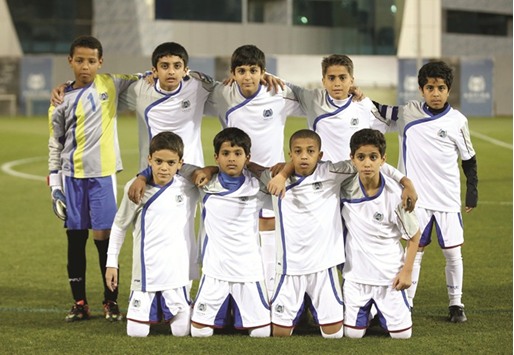
Aspire Academy’s U-12 players pose for a team photo ahead of their match.