


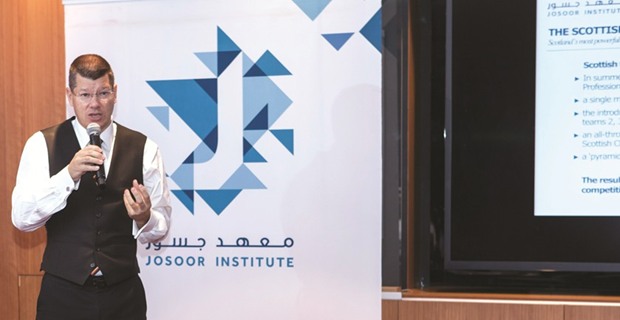
In an exclusive chat with Gulf Times, Doncaster spoke about the Scottish League, his fan-enhancement experience at Norwich, his view on the footballing facilities in Qatar and tips on increasing the fan base of the local clubs here. Here are excerpts from that interview:
How would you describe the growth of the Scottish Premiership over the years?
Since the SPFL was created in the summer of 2013, we have seen a continual growth and positive progression across all four leagues. At stadiums, total crowd figures are also on the rise and that looks set to continue this season. Perhaps the biggest game-changer behind the growth and rising interest in the SPFL has been the introduction of a Scottish Premiership play-off at the end of each season. It gives more clubs an opportunity to reach our top league and has also strengthened the quality and competitiveness of our second tier. We’re really pleased with what has been achieved in just four years, thanks to the input and sacrifice of clubs, and we are all working together to continue that constant progress.
How can it stand out among the other big leagues – EPL, La Liga, Bundesliga etc.?
I think that’s a question not only for Scottish football but for the leagues of other countries all across Europe. In fact, even La Liga and the Bundesliga look at English TV money with envious glances. What the SPFL can do to stand out against other leagues is celebrate what we have – unrivalled history and passion and the highest percentage of population attending top flight games of anywhere in Europe.
Just as importantly, if not more so, we need to innovate and create drama and talking points which help generate excitement, attract attention and bring in more investment. The new format of our Scottish League Cup, which helped secure a new title sponsor in Betfred, is a great example of that. By innovating and providing competitive summer football, a short group format and penalty shoot-outs after drawn games, we are taking something different to the market which has been really enjoyed by fans and a wider TV audience.
Can you tell us about your experience at Norwich City? What specific community building activities did you conduct to increase awareness about the club?
Our strategy was based on family-friendly policies. While young fans might be able to enjoy seeing their footballing heroes at Manchester United, Liverpool and Chelsea on the television, they would never get to meet them in person. Our approach was based on making live football accessible and affordable to families and creating an environment where young fans really could meet their heroes. Only their local football club could deliver that sort of experience, which helped to create a new generation of supporters.
What advice would you give to clubs in Qatar to increase their fan base?
It’s important to remember that many football clubs in the UK have histories going back to the 1880s and, in some cases, even earlier. Affinity to particular clubs has been passed down from generation to generation, creating deep family ties to the local club, and binding fans to ‘their’ club for life.
Whilst there a number of clubs in Qatar with proud histories of sporting success since the creation of the Qatar Stars League in 1963, we have to remember that the football industry in Qatar is still relatively young. And so I would urge patience as those entrusted with the responsibility of growing clubs’ fan bases carry out their important work.
How can the clubs in Qatar go about increasing stadium attendance? Are there any specific activities that you would recommend?
By focussing on enhancing the match day experience for fans, as well as creating stronger emotional ties between clubs and fans, I believe clubs in Qatar will be well placed to benefit from the increasing levels of interest and excitement in football in the region as 2022 approaches.
Have you had the chance to look at the football facilities in Qatar? If yes, what is your opinion on them?
Over the past few years, I have been privileged to attend a number of games at various stadia in Qatar and have been universally impressed with their bold design, build quality and individual character of each. And in Aspire Zone, Qatar possesses one of the planet’s foremost sporting facilities – a truly world class undertaking.
I have no doubt when the world comes to Qatar in 2022 that very many people will be struck by the breathtaking level of footballing ambition demonstrated by the nation.
Qatar will be hosting the World Cup in 2022. What can the football clubs here do to promote the game till then?
Those entrusted with the responsibility of running the clubs in the QSL have done a good job in promoting the league, its clubs and football in Qatar. Indeed, the profile of the QSL overseas is very high, particularly given that it is a younger league than many other professional football leagues around the world.
Can you tell us about Josoor Institute’s Football and Sports Management Programme?
The Football and Sports Management programme is a 12-month programme delivered in six blocks. It focuses on providing a broad understanding of the complexities that come with the management of sports generally and football specifically. The programme is delivered on a part-time basis to allow flexibility for those with full-time commitments.
And how relevant is this programme looking at the focus on sports in Qatar?
As all programmes developed by Josoor Institute under its mandate developed by the Supreme Committee for Delivery & Legacy, this programme is very relevant. When designing the programme, we looked at the nature and gaps of the sports industry in this region. We made it specifically for professionals in the region to give them the knowledge and skills they need to be able to successfully deliver the upcoming major and sports events set to take place in Qatar and the region.