


Asian markets swung yesterday as investors were on edge over geopolitical tensions, with US-Russian relations strained by last week’s Syria strike and sabre-rattling on the Korean peninsula.
While stocks pared the initial plunge that met news of the US missile attack on a Syrian airbase, the brewing crisis is keeping dealers on edge heading into the company earnings season.
President Donald Trump’s administration has rankled Moscow by saying it sees no peace in civil war-hit Syria while Bashar al-Assad remains president, while Russia has described the strikes as inflicting “considerable damage” to already “lamentable” bilateral ties.
The US said the strike was in retaliation for a chemical attack on rebel forces that killed dozens.
US Secretary of State Rex Tillerson will visit Moscow this week to discuss the crisis with his counterpart Sergei Lavrov as members of the Group of Seven leading economies are meeting in Italy to hammer out a plan aimed at getting Russia to rein in Assad.
Shanghai gained 0.6% while Sydney added 0.3% and Wellington ticked up slightly.
But Tokyo ended 0.3% lower and Hong Kong was down 0.7% while Singapore gave up 0.2% and Taipei slipped.
Toshiba plunged 2.7% on uncertainty about its scheduled release of earnings for April to December.
Some reports say it is considering unveiling the twice-postponed report without auditor approval but the leading business daily Nikkei said it might put it off again.
The stories overshadowed reports that Taiwan’s Foxconn had told cash-strapped Toshiba it is prepared to pay $27bn for its computer-chip business, the firm’s prized possession.
Seoul was 0.4% lower on concerns about North Korea tensions after Pyongyang hit out at the US deployment of a naval strike group to the Korean peninsula, warning it was ready for “war” in a further escalation of tensions.
On oil markets, both main contracts held up since Friday’s attack, which flamed speculation about the impact on exports from the crude-rich Middle East.
US benchmark West Texas Intermediate is up almost 3% since the strike while Brent has added more than 2%, with the closure of a Libyan oilfield also providing support.
The dollar fell against the yen after US Federal Reserve boss Janet Yellen said the central bank would stick to its plans to raise interest rates only gradually.
“It looks difficult for the yen to weaken significantly from here, given Yellen’s stance for slow-paced rate hikes,” Hiroyasu Iida, the head of the investment research centre at Aizawa Securities, told Bloomberg News.
In Tokyo, the Nikkei 225 closed down 0.3% at 18,747.87 points; Hong Kong — Hang Seng fell 0.7% at 24,088.46 points and Shanghai — Composite closed up 0.6% at 3,288.97 points yesterday.
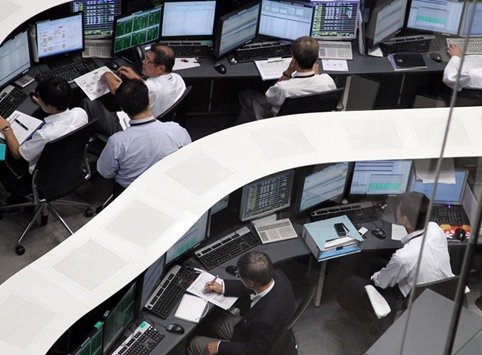
Employees work on the trading floor of the Tokyo Stock Exchange. The Nikkei 225 closed down 0.3% to 18,747.87 points yesterday.