


As most of the trading world moves on from Donald Trump’s missile attack on Syria, there’s one pocket of the market where anxiety is lingering: South Korea.
The country’s Kospi index was the biggest decliner in Asia yesterday, falling the most in more than five weeks as the won led losses among major and emerging-market currencies. While the US strike on Syria’s Shayrat Airfield took place some 4,700 miles from Seoul, traders have been quick to make the connection – selling off South Korean assets on speculation Trump could make a similarly aggressive pivot when it comes to the recalcitrant North.
The attack is unnerving a market that has proven pretty resilient to North Korea’s sabre-rattling this year. Though some South Korean equities have been vulnerable to losses on rising tensions in the region, the Kospi remains up 5.3% in 2017, on par with the advance in global stocks.
While Secretary of State Rex Tillerson emphasised on Sunday the US wasn’t seeking “regime change” in North Korea, an American aircraft carrier bound for Australia has been diverted to North Asia in the wake of the Syria move. The much-anticipated meeting between Chinese President Xi Jinping and Trump at the end of last week also ended with no mention of any concrete measures to defuse tensions with the North.
“Obviously, there may be a more confrontational US given how the strike force is deployed closer to the Korean peninsula,” said Vishnu Varathan, a senior economist at Mizuho Bank in Singapore. “Despite the cordial meeting between Trump and Xi we really don’t know how China views the geopolitical issues.” The won dropped 0.7% to 1,142.38 per dollar yesterday, touching its weakest level since March 15 earlier in the session. The currency could dip to as low as 1,145 this week amid the spectre of rising tensions, according to Commonwealth Bank of Australia.
As the cost of hedging against losses in the won spikes, banks are reiterating short bets on the currency.
Australia & New Zealand Banking Group said the won looks susceptible to more declines, extending its long recommendation on Indian rupee non-deliverable forwards versus their Korean counterparts. Gao Qi, an emerging-markets Asia currency strategist at Scotiabank in Singapore, reaffirmed his advice to bet on gains in the yuan against the won, saying China’s currency stands to benefit on US policy tightening and an uptick in regional concerns. Clothing and transport stocks drove the Kospi down 0.9% in a fifth straight day of declines, the longest slump since June. Defence stocks benefited, however, with Victek Co, a manufacturer of electronic warfare products up 30%, and Seoul-based Speco Co, which makes water jets used on naval vessels, jumping 26%.
While defence-sector shares are surging now, the impact is likely to wane, said Min Byung-kyu, an analyst at Yuanta Securities Korea Co in Seoul. “I don’t expect geopolitical risks to linger in the longer term.”
Yields on South Korea’s 10-year government bonds, meanwhile, climbed six basis points to 2.25% yesterday, the steepest increase since March 2.
“The US-China summit has not produced a clear solution about North Korea’s nuclear issues, and geopolitical risks persist,” said Han Yun-ji, an economist at Shinhan Investment Corp in Seoul.
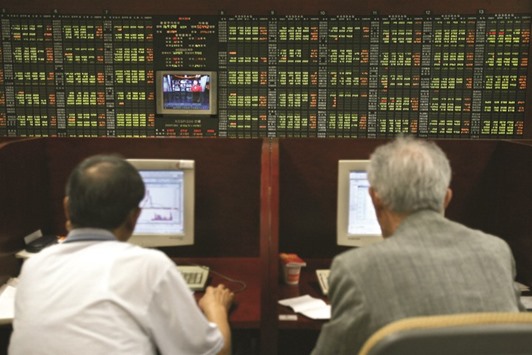
Investors monitor stock prices in Seoul. The Kospi index was the biggest decliner in Asia yesterday, falling the most in more than five weeks as the won led losses among major and emerging-market currencies.