


Hundreds of foreigners lined up in Pyongyang’s Kim Il-sung Stadium yesterday for the city’s annual marathon, the highlight of the tourism calendar in isolated North Korea.
The 40,000-plus capacity ground was packed for the event, the crowd warmly applauding as the runners gathered on the artificial pitch, with portraits of the North’s founding father Kim Il-sung and his late son and heir Kim Jong-il smiling down benignly from the roof.
The event is part of the commemorations for the anniversary of Kim Il-sung’s birth on April 15, 105 years ago, and a row of dignitaries sat in a VIP section — at least four of them in military uniform.
Nearly 2,000 people entered the event, more than half of them foreigners — mostly Europeans and other Westerners. They took part even though the North is under multiple sets of United Nations sanctions over its nuclear and ballistic missile programmes, and Washington is diverting a carrier strike group towards the Korean peninsula as tensions mount.
“It’s a bit surreal, where we are,” said Irishman Richie Leahy, 35, who likes holidays that are “more of an adventure”.
“This just ticked all the boxes,” he said. “I took part in a sporting event in North Korea: it’s not something that everyone can say.”
Soon after the start the course passed an obelisk declaring “The great leaders Kim Il-sung and Kim Jong-il will always be with us”.
The runners made their way past city landmarks including Kim Il-sung Square and Mansu hill, where giant bronze statues of the two men gaze out over their capital. Local runner Pak Chol, 27, established a commanding lead in the men’s race several kilometres out and recorded his third victory in the event in 2 hours 13 minutes and 56 seconds. His compatriot Jo Un-ok was the first woman across the line in 2:29’23”.
Despite the geopolitical tensions – only last week the UN Security Council condemned the North’s latest missile launch — knots of spectators gathered along the route, cheering the runners on and exchanging high-fives with them.
Spontaneous encounters with North Koreans are normally rare on visits to the Democratic People’s Republic of Korea (DPRK), as the country is officially known. “Really being with people, greeting them, touching them. It’s really quite something,” said Soleiman Dias, an international school admissions director from Fortaleza in Brazil, who described the run as “the experience of a lifetime”.
Critics say that tourism to the North helps to bolster a regime accused of widespread human rights abuses as well as its weapons ambitions, which include developing a missile capable of delivering a nuclear warhead to the continental United States.
Among a host of measures, the United Nations sanctions include a cap on coal exports, by far the North’s biggest foreign currency earner, but do not directly ban tourism.
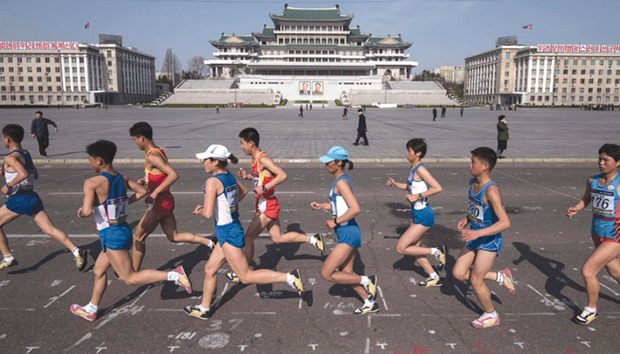
Competitors run through Kim Il-sung square in central Pyongyang.