


Global foreign-exchange reserve managers boosted holdings of yen assets by the most since at least 1999 in the fourth quarter, according to Bloomberg analysis based on data from the International Monetary Fund.
Central banks acquired $35.3bn of yen-denominated assets, more than double the $14.9bn they snapped up in the previous three months, and the most since the IMF started released quarterly data in 1999. The amount was adjusted for fluctuations in the exchange rate and deflated by asset returns.
FX reserve managers tapped demand for dollars from Japanese investors seeking higher returns overseas as the nation’s central bank keeps the benchmark 10-year bond yield close to zero.
The discount in the interest rate that investors enjoy to borrow yen in exchange for dollars slid to minus 94 basis points on November 29, the lowest since at least 2011, according to data on three-month basis swaps compiled by Bloomberg.
“The decline in basis swaps boosted the relative attractiveness of yen-denominated assets amid the global low-yield environment,” said Takahiro Sekido, a former Bank of Japan official who is now a strategist at Bank of Tokyo-Mitsubishi UFJ Ltd in Tokyo. “The increased yen allocation may also be part of investment diversification among global foreign reserves.”
An investor who offers dollars via a foreign-exchange swap and deposits yen in Japan’s three-month treasury-discount bills gains a yield that’s more than 50 basis points higher than similar-maturity US debt, data compiled by Bloomberg show.
Foreign ownership of Japan’s treasury bills climbed above 50% for the first time in the fourth quarter, a report from the Bank of Japan showed last month.
While the IMF report doesn’t reveal a country breakdown, data from Japan’s balance-of-payments report showed Chinese and French investors were the biggest buyers of the nation’s debt after the UK in the fourth quarter. Chinese funds boosted holdings by ¥3.23tn ($29bn), while French ones bought a net ¥2.08tn.
The inclusion of China’s reserves starting in 2015 may have distorted the IMF data.
The nation started to report a representative portfolio on a partial basis and is gradually increasing the portfolio to full coverage within two to three years.
Meanwhile Japanese stocks are turning off overseas investors and one thing that could lure them back is a weaker yen, according to Jim McCaughan, who oversees more than $400bn at Principal Global Investors.
“Foreign investors are leaving because they see limited potential for growth in the domestic economy,” he said in an interview in Tokyo. “The thing that will get the foreign investors coming back might be weakness in the yen, or it might be some government policy that was more pro-growth.”
The Topix erased all of its year-to-date gain last week as the yen surged toward a four-month high against the dollar, pummelling shares of Japanese exporters. For a dollar-based investor, the benchmark has climbed 3.6% since the end of last year, while the S&P 500 Index gained 5.3%.
Foreign investors sold more than ¥1tn ($9bn) of Japanese equities in March, bringing their net sales of domestic stocks to ¥1.2tn this year through last week. They offloaded shares for seven consecutive weeks through March 31, the longest streak since early 2016. Last year, foreigners sold a net amount of more than ¥3tn.
McCaughan said he expects Japanese stocks and the yen to remain stable for the next few quarters. A major policy shift by the government or Bank of Japan would change that view, he said.
The yen will end the year at 117 per dollar, according to the median analyst estimate in a Bloomberg survey. It was at 110.54 on Friday.
“Unless you see weakness in the yen, or some other form of stimulus, growth will be limited,” he said. “I think that’s what foreign investors really are looking for.”
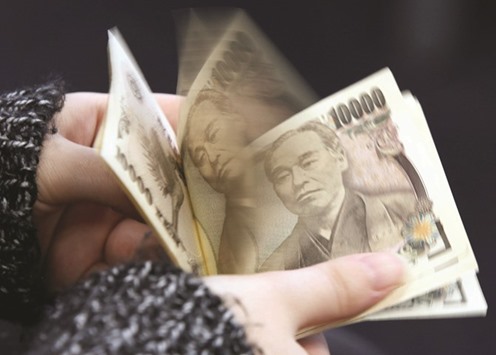
A woman counts yen notes in Tokyo. Global foreign-exchange reserve managers boosted holdings of yen assets by the most since at least 1999 in the fourth quarter, according to Bloomberg analysis based on data from the International Monetary Fund.