


South Korea’s flag flew and its anthem sounded in Pyongyang yesterday as its women’s football team played out a 1-1 draw with their neighbours, in the first ever competitive soccer match between the two countries hosted by the North.
A packed crowd at the 40,000-plus capacity Kim Il-Sung stadium stood to hear the South Korean national song in respectful silence, before belting out the North’s hymn.
Every touch by the home team in attack or defence was cheered to the rafters, with supporters waving golden cardboard megaphones. The only previous encounter in Pyongyang between footballers from the two sides was a pro-unification match between the men’s teams in 1990, when both used a flag showing the whole Korean peninsula and their respective anthems were not played.
The North won 2-1.
Since then, games nominally hosted in the Democratic People’s Republic of Korea, as the North is officially known, have had to be played on neutral ground due to authorities’ reluctance to see the South’s flag fluttering in their capital.
A few hours south of Pyongyang the North Korean military faces off against US-led United Nations forces across the Demilitarized Zone, considered one of the most heavily fortified locations on Earth.
The match came as the North’s nuclear ambitions top the agenda at a meeting between US President Donald Trump and his Chinese counterpart Xi Jinping after Pyongyang’s latest missile launch this week in violation of UN resolutions and condemned by the Security Council.
The two Koreas are technically at war because the 1950-53 Korean conflict ended with an armistice rather than a peace treaty, and relations have plunged in recent months.
Seoul demanded security guarantees for the players before authorities approved the trip.
The South’s coach Yoon Duk-Yeo — who was on the losing side in the 1990 unification game — reportedly installed loudspeakers at a training ground to replicate the expected aural barrage.
But the Group B qualifier for the AFC Women’s Asian Cup offered a rare chance for a moment of detente between the two.
Sporting links “have eased anxieties during times of escalating tensions” said Michael Spavor, director of Paektu Culture Exchange, which facilitates exchanges in multiple fields with the North. Koreans on either side of the border tend to back each other’s teams when they play other countries.
Two gymnasts from the North and South posed for a selfie at the Rio Olympics last year and the image instantly went viral, symbolising hopes for closer ties.
When Koreans from both sides of the divide meet, said Spavor, there is “genuine curiosity... and even a little bit of anxiety, which creates a kind of tension”.But at sports events participants “get lost in the moment”, he told AFP. “Many athletes realise afterwards how special an experience it was and they can naturally get a bit emotional.”
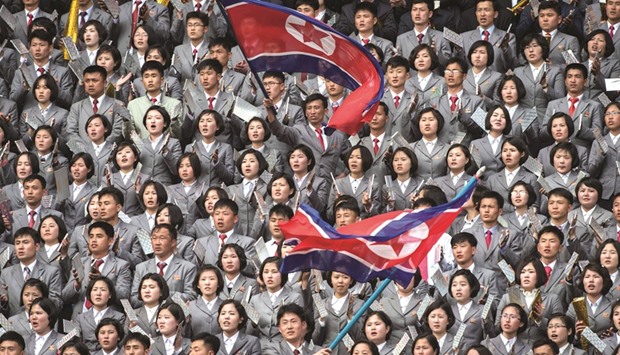
North Korea fans wave flags as they support their team against South Korea during their AFC Women’s 2018 Asian Cup match at the Kim Il-Sung stadium in Pyongyang yesterday.