


Gambians voted yesterday in the first election since longtime leader Yahya Jammeh left power, with opposition parties set to gain seats after being left in the cold for years during what was tantamount to one-party rule.
More than 880,000 Gambians are eligible to vote and polls are open until 5:00pm, with many voters relishing the chance to express varied political opinions after 22 years under Jammeh.
“The only way Gambians can consolidate our newfound democracy is for people to ensure they elect competent individuals that will represent them in parliament and help in making the government’s reform agenda a reality,” said Fatou Suwareh, who was waiting in line to vote on the outskirts of Banjul.
The full results are expected by today afternoon.
The election is a key test for several former opposition parties that united to form the coalition in December to oust Jammeh from power and deliver flag bearer Adama Barrow to victory as the new president.
Internal tensions mean those parties are not running together in Thursday’s legislative elections, and some voters expressed anger that the organisations involved had not been able to present a united front.
Posing a threat is the Gambia Democratic Congress (GDC), a youth-led party which did not join the governing coalition whose leader Mama Kandeh came third in last year’s presidential vote.
“The coalition was my party but when things started falling apart with them, everyone has to go to their party,” said Yaisa Jawara, casting her vote at a roadside polling station near the capital, Banjul, who chose the GDC as a protest vote.
“They (GDC) are not very experienced but they are willing to work with the government,” she added.
Barrow attempted to shrug off accusations that his coalition was permanently damaged by infighting, which at times has broken out into the open in Gambian media.
“There is no (cabinet) split, this is about democracy and this is the new Gambia,” he said after casting his vote.
The Independent Electoral Commission (IEC) expressed concern around midday that turnout appeared to be low, with many Jammeh supporters expected to stay at home as his Alliance for Patriotic Reorientation and Construction (APRC) recovers from its shock loss in the presidential election.
“We just hope that the voter turnout increases,” said Manneh Sallah, vice-chairman of the electoral commission.
EU observer Maria Arena, from Belgium, also told AFP that after a busy start “turnout is a little low”.
Sallah hailed the “record number” of 238 candidates standing for office, saying it showed “a lot of interest in our democracy after the change.”
There is no formal opinion polling in the small west African nation, making it difficult to establish voting intentions, but the APRC was only able to muster candidates in just over half the country’s constituencies, meaning they cannot obtain the near-total majority achieved in past elections.
Alagie Bubacar Jallow, an unemployed hotel worker voting in Bakau, just outside the capital, said his town had long been ignored by the Jammeh regime because it was seen as an opposition stronghold.
“We need things to be done in Bakau,” he told AFP.
“I’m voting for Assan Touray, UDP, but more for the candidate. He is loyal, ambitious and respectful of all the people. He can try and fight for the needs of the town.”
The United Democratic Party (UDP) has waited many years for the chance to take some of the 53 seats up for grabs in The Gambia’s National Assembly, with its activists and leaders routinely imprisoned and abused by Jammeh’s security forces.
“Gambians are coming out to complete the establishment of a new government,” UDP leader Ousainou Darboe, who serves as foreign minister in Barrow’s coalition cabinet, said after casting his vote.
Five extra places are appointed by the president, for a total of 58 seats in the legislative chamber, which was long derided as a rubber stamp for Jammeh’s executive orders.
The African Union, the regional bloc ECOWAS and the European Union have all sent observers to monitor voters casting their ballots in The Gambia’s unique system, where marbles are dropped into coloured metal barrels representing different candidates.
West African troops remain in The Gambia three months after Jammeh’s departure, and will stay until Barrow is satisfied that reforms of the security service have removed rogue elements.
Experts say that while the result could go feasibly in any direction, the relative novelty of a truly democratic election might fail to produce the unified front required to carry out the comprehensive overhaul of the state promised by Barrow.
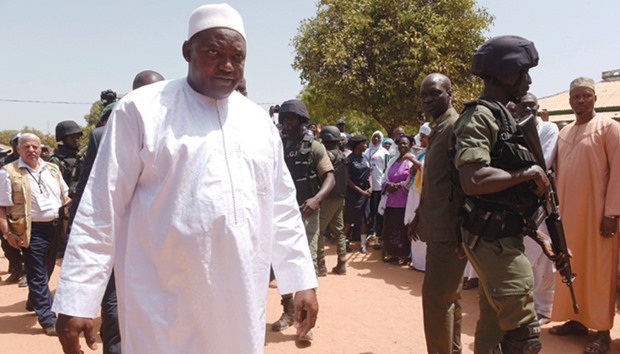
President Adama Barrow arrives at a polling station in Bakau yesterday.