


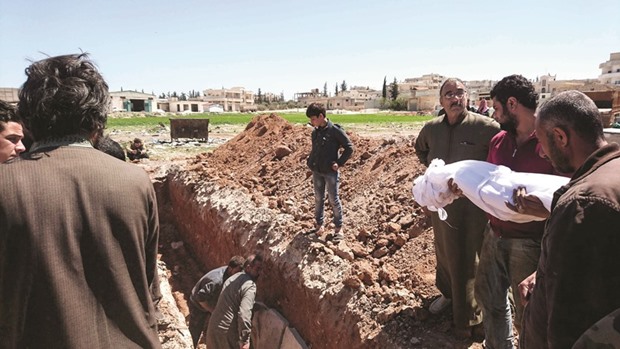
Western countries, including the United States, blamed Assad’s armed forces for the worst chemical attack in Syria for more than four years, which choked scores of people to death in the town of Khan Sheikhoun in a rebel-held area on Tuesday.
US intelligence officials, based on a preliminary assessment, think the deaths were most likely caused by sarin nerve gas dropped by Syrian aircraft.
But Moscow offered an alternative explanation that would shield Assad: that the poison gas belonged to rebels and had leaked from an insurgent weapons depot hit by Syrian bombs.
A senior White House official, speaking on condition of anonymity, said the Russian explanation was not credible. “We don’t believe it,” the official said.
The United States, Britain and France have proposed a draft UN Security Council resolution that would pin the blame on Damascus.
But the Russian Foreign Ministry called the resolution “unacceptable” and said it was based on “fake information”. The US ambassador to the United Nations Nikki Haley issued what appeared to be a threat of unilateral action if Security Council members could not agree. “When the United Nations consistently fails in its duty to act collectively, there are times in the life of states that we are compelled to take our own action,” Nikki Haley told the Security Council, without elaborating.
Trump described the attack as “horrible” and “unspeakable” and called it a “terrible affront to humanity”. Asked whether he was formulating a new policy towards Syria, Trump told reporters: “You’ll see.”
Video uploaded to social media showed civilians sprawled on the ground, some in convulsions, others lifeless.
Rescue workers hose down the limp bodies of small children, trying to wash away chemicals.
People wail and pound on the chests of victims.
The charity Medecins Sans Frontieres said one of its hospitals in Syria had treated patients “with symptoms — dilated pupils, muscle spasms, involuntary defecation — consistent with exposure to neuro-toxic agents such as sarin”. The World Health Organization also said the symptoms were consistent with exposure to a nerve agent.
Turkish President Tayyip Erdogan said the attack had killed more than 100 people. That death toll could not be independently confirmed.
“We’re talking about war crimes,” French UN ambassador Francois Delattre told reporters in New York.
Hasan Haj Ali, commander of the Free Idlib Army rebel group, called the Russian statement blaming the rebels a “lie” and said rebels did not have the capability to produce nerve gas.
“Everyone saw the plane while it was bombing with gas,” he told Reuters from northwestern Syria. “Likewise, all the civilians in the area know that there are no military positions there, or places for the manufacture (of weapons).”
The incident is the first time Washington has accused Assad of using sarin since 2013, when hundreds of people died in an attack on a Damascus suburb.
At that time, Washington said Assad had crossed a “red line” set by then-president Barack Obama. Obama threatened an air campaign to topple Assad but called it off at the last minute after the Syrian leader agreed to give up his chemical arsenal under a deal brokered by Moscow, a decision which Trump has long said proved Obama’s weakness.
The new incident means Trump is faced with same dilemma that faced his predecessor: whether to openly challenge Moscow and risk deep involvement in a Middle East war by seeking to punish Assad for using banned weapons, or compromise and accept the Syrian leader remaining in power at the risk of looking weak.
Trump described Tuesday’s incident as “heinous actions by the Bashar al-Assad regime” and faulted Obama for having failed to enforce the red line four years ago.
Obama’s spokesman declined to comment.
The draft UN Security Council statement condemns the attack and demands an investigation.
Russia has the power to veto it, which it has done to block all previous resolutions that would harm Assad, most recently in February.
France’s foreign minister said the chemical attack showed Assad was testing whether the new US administration would stand by Obama-era demands that he be removed from power.
“It’s a test. That’s why France repeats the messages, notably to the Americans, to clarify their position,” Jean-Marc Ayrault told RTL radio.
“I told them that we need clarity. What’s your position?”
Trump’s response to a diplomatic confrontation with Moscow will be closely watched at home because of accusations by his political opponents that he is too supportive of Russian President Vladimir Putin.
His relationship with Russia has deteriorated since the presidential election campaign, when candidate Trump praised Putin as a strong leader and vowed to improve relations between the two countries, including a more co-ordinated effort to defeat Islamic State in Syria.