


Indian shares touched a new high a day before the central bank’s monetary policy meeting, boosted by a rally in property developers. The benchmark Sensex and the NSE Nifty 50 indexes, which reopened after a holiday, extended Monday’s record levels.
The BSE Sensex closed higher yesterday by 64 points or 0.21% to 29,974, while the Nifty 50 rose 27 points or 0.30% to 9,265.
Adani Ports & Special Economic Zone rallied 4.7% to its highest close since August 2015, as it considers building a port in Malaysia. Mortgage lender Housing Development Finance Corp dropped 2.8% after saying profit on investments sale will be Rs490mn in the January-March quarter compared with Rs15.2bn a year earlier.
Ten of the 13 sector gauges compiled by BSE rose paced by the S&P BSE Realty Index. The measure of 10 property developers jumped 4.1% to its highest level since April 2015. Sobha led gains, surging 17%. The company posted its steepest gain in a day since November 2009 after an exchange filing showed its revenue in the quarter ended March rose 35% from the previous three months.
Despite key Indian equity benchmarks at new peaks, some strategists see more room for gains amid a revival in inflows from overseas investors, along with local fund purchases. CLSA India raised Nifty’s target for March 2018 by 3% to 10,000 and said that lower equity supply and “large investor flows” will keep valuations elevated, according to an April 3 note.
Investors now await the outcome of the Reserve Bank of India’s monetary policy meeting today. All the 50 economists surveyed in a Bloomberg poll predict that the central bank will keep the key repurchase rate unchanged at 6.25%.
“After the RBI changed its stance from accommodative to neutral in its previous policy meeting, investors will be closely watching the commentary tomorrow,” said Hyderabad-based Jagannadham Thunuguntla, head of fundamental equity research at Karvy Stock Broking. Overseas investors bought $6.7bn of local stocks in the first quarter, the highest among major Asian markets. The purchases follow a record $4.6bn quarterly outflow in the October-December period, according to data compiled by Bloomberg.
Meanwhile strategists are scrambling to raise their year-end forecasts for India’s rupee after the biggest quarterly gain in more than four years took them all by surprise. The rupee climbed 0.2% to 64.8825 per dollar in Mumbai yesterday.
Citigroup, Credit Suisse Group and Barclays are among at least eight global banks to upgrade their estimates in the past three weeks. The rupee jumped 2.8% in March to cap its best monthly gain in a year, thanks to a surge in foreign inflows following a win for Prime Minister Narendra Modi in key state elections. Its 4.7% advance last quarter is the largest since September 2012.
“The rupee’s strength likely caught the market by surprise, and was largely guided by inflows into Indian assets, broad dollar weakness and tapering of expectations of US policy” tightening, said Dushyant Padmanabhan, a currency strategist at Nomura Holdings in Singapore. “We expect bond inflows to continue while the growth outlook should support broader inflows, and hence will be positive for the rupee.”
The new estimates indicate that most of the forecasters expect the currency to weaken from here. Interest-rate increases by the Federal Reserve will spur flows back to the US dollar, according to the strategists.
Some of them also expect intervention by the Reserve Bank of India – which during this rupee surge appears to have grown more tolerant of currency gains – to intensify in case more money flows into the nation’s assets.
“The global backdrop has been positive for EM currencies, particularly high-yielders like India, and the outcome of state elections has given, from the perception of foreign investors, a green light for further reforms by PM Modi,” said Mitul Kotecha, head of Asia currency and rates strategy at Barclays in Singapore. “On top of that, it does appear that the stance of the central bank has changed with regard to limiting or capping INR gains.”
Foreign holdings of rupee-denominated government and corporate bonds climbed by about Rs360bn ($5.5bn) last quarter, with Rs272.6bn coming in March alone, the most for any month in National Securities Depository’s data going back to mid-2011. Overseas funds poured $6.7bn into Indian stocks in the January-March period, of which $5.1bn came last month.
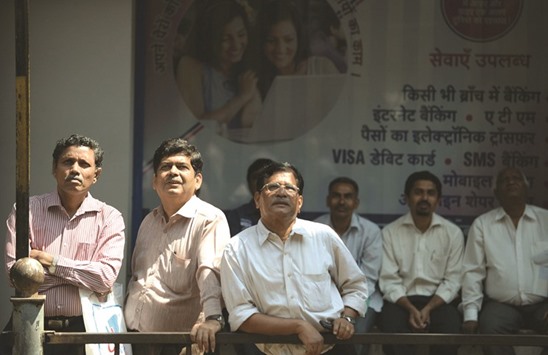
Bystanders watch share prices displayed on a digital broadcast on the facade of the Bombay Stock Exchange building in Mumbai. The BSE Sensex closed up 0.21% to 29,974 points yesterday.