
China’s four-year push to turn the yuan into one of the world’s premier reserve currencies has a long way to go.
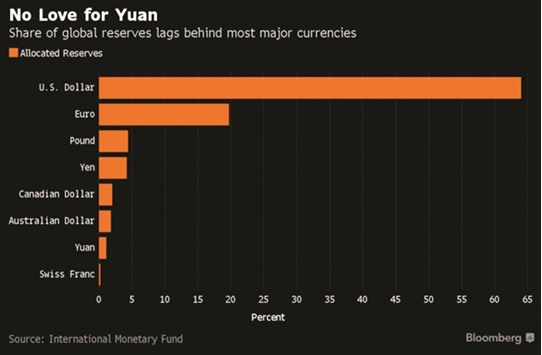
Global central banks had $84.5bn, or 1.1%, of allocated reserves in the yuan as of the end of 2016, according to the International Monetary Fund’s inaugural disclosure of the data on Friday. The tally trails the dollar’s 64% share, and also places the yuan behind currencies including the euro, yen, pound and the Australian dollar.
In the face of a weakening yuan, persistent capital flight and an uncertain growth trajectory, yuan-denominated bonds and stocks are proving a hard sell even to central bankers who have expressed interest in the past. Instead of the yuan, reserve managers are more inclined to accumulate dollars in a category of holdings known as liquidity portfolios, which can be bought or sold to influence local exchange rates. In fact, the dollar’s share rose from 61% in 2014.
The disclosure comes after the yuan was added to the IMF’s Special Drawing Rights basket last year. The data show that inflows from official accounts have done little to offset capital outflows, as some analysts and investors had anticipated. “The new data series may re-focus the market’s attention on an old question: when will the yuan become a reserve currency, and will the process offset the bearish pressure from pent-up outflows?” Sebastien Galy, a strategist at Deutsche Bank in New York, wrote in a report before the data’s release. “Global reserve managers are unlikely to reallocate meaningfully” to the yuan “in the foreseeable future.”
The lack of enthusiasm follows a push by Chinese authorities to widen foreign access to the yuan. The People’s Bank of China removed an investment cap on foreign central banks and sovereign wealth funds in 2012, and made it easier for these investors to trade in its interbank bond market in 2015.
It may take years for the yuan to establish a meaningful presence in global reserves. It could account for 5% to 10% of the total in a decade, according to Eswar Prasad, former head of the IMF’s China division and author of “Gaining Currency: The Rise of the Renminbi.”
The yuan will “conceivably rival the yen, the pound, and could even significantly erode the euro’s dominance in international finance, but there is little prospect of it rivalling the dollar,” Prasad said in a Bloomberg interview in September.
Business / Business
China’s 4-year push to turn yuan into one of the world’s premier reserves has a long way to go


.