


Sidra Medical and Research Centre (Sidra) has adopted an approach for caring for children with Autism Spectrum Disorder (ASD) by providing care for the whole family. The concept ties in closely with Sidra’s overall goal to provide patient and family-centred care across all facets of health delivery.
Sidra is currently part of a National Autism Working Group, under the auspices of the Ministry of Public Health. The group includes a dedicated consortium of various ministries, the public and private sector, hospitals and most importantly parents and caregivers who are part of the Qatar Autism Families Association.
The group is working closely to finalise a Qatar National Autism Plan, based on six pillars – Awareness; Early Recognition and Screening; Diagnosis and Assessment; Interventions; Education and Transition into Adolescence, Adulthood and Elderhood.
While there is still room for further enhancement in the services currently available for children and youth with ASD in Qatar, over the last few years there has been a significant change in society’s attitudes towards accepting them into the community fold, Sidra said in a statement yesterday.
From more easily accessible clinical services, support groups, behavioural therapies to school-based programmes – there is a growing network of support services now available for families in Qatar.
At Sidra, the Developmental Paediatrics and Child and Adolescent Psychiatry clinics currently provide multiple services for children and young people with ASD. This includes comprehensive diagnostic assessments and treatment recommendations. The clinics also provide evaluation services for children with comorbid emotional and psychiatric issues.
Dr Fatima Janjua, division chief of developmental paediatrics, explained that, children referred with suspected ASD participate in a multidisciplinary assessment, on the same day, by a team of doctors, psychologists, therapists and nurses. This approach allows for a more accurate and immediate diagnosis, which in turn leads to earlier intervention.
Dr Ahsan Nazeer, division chief of child and adolescent psychiatry from Sidra said: “Family is an integral part of the care and significant effort goes into educating them during sessions at our clinic. With the right support to the families – they in turn can help their child to learn, grow and thrive. Each family receives a detailed report of initial evaluation about the child. The report provides a valuable record of the current functioning, diagnosis of the child and possible treatment recommendations. Families can share this report with schools and different community organisations to receive appropriate services for their child.”
Sidra’s clinicians have shared some tips for parents of children with ASD such as focusing on the positive side by encouraging the children.
They also point out that one of the most important factors in the child’s progress is parents’ acceptance and participation in the intervention programme. Moreover, children with ASD feel safe and secure when they know what to expect each day. Page 28
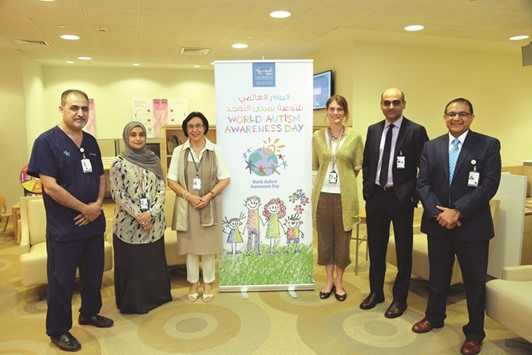
Sidra clinicians who participate in caring for children with ASD.