


South Korea’s exports grew more than expected in March thanks to stronger global demand, even as souring relations with China, its biggest trading partner, continue to pose risks to its economy.
Shipments in March rose 13.7% to $48.88bn from a year earlier, while imports jumped a faster 26.9% to $42.32bn, resulting in a trade surplus of $6.55bn, government data showed yesterday.
Exports had been expected to expand by 13% in March, marking the fifth straight month of gains, according to a Reuters poll. They had jumped 20.2% in February, the strongest pace in five years. Imports surged the most since September 2011, signalling a rebound in domestic demand after months of weakening consumer sentiment amid a corruption scandal that led to the ouster of president Park Geun-hye.
Economists had expected a 23.7% expansion. Park Sang-hyun, chief economist at HI Investment & Securities, said South Korea is well positioned to benefit from improving global economy and temporary factors including the new flagship smartphone Galaxy S8 released by Samsung Electronics Co Ltd.
Exports comprise roughly half of South Korea’s economy.
“There could be some softness from US demand but overall, the improving global economy will continue to lift South Korean exports,” Park said.
Sustained improvement in global demand would support a modest recovery in Asia’s fourth-largest economy, although Seoul sees worrying signs that China may be stepping up economic retaliation over its decision to deploy a US anti-missile system.
South Korean officials suspect that Beijing is indirectly taking action to curb some consumer products and cultural imports from South Korea.
Last month, Chinese authorities closed dozens of retail stores of South Korea’s Lotte Group following inspections.
Some Chinese airlines have stopped website offers of flights to South Korea.
South Korea’s exports to China jumped 12.1% on-year in March, slowing from a 28.8% jump in February but still rising for a fifth straight month on improving sales of semiconductors and petrochemical products.
Despite the spat, overseas sales of cosmetic products posted a record jump of 35.3% in the first quarter.
Shipments to the United States fell 5.3% in March year-on-year due to weaker sales of telecommunication devices and car components.
That led to a reduced trade surplus of $1.82bn for South Korea over the United States, from $2.75bn a year earlier, the ministry said.
The average export value per working day stood at $2.04bn in March, compared to $1.96bn in February, according to Reuters calculations.
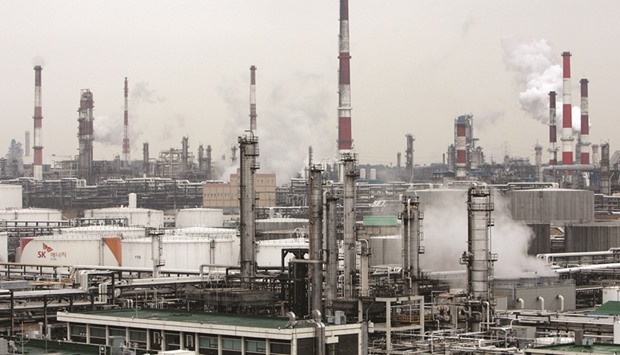
South Korea’s top refiner SK Energy’s main factory in Ulsan, southeast of Seoul. South Korea’s shipments in March rose 13.7% to $48.88bn from a year earlier, while imports jumped a faster 26.9% to $42.32bn, resulting in a trade surplus of $6.55bn, government data showed yesterday.