


Millions of Dutch flocked to the polls yesterday in a test of the “patriotic revolution” promised by far-right MP Geert Wilders, with Europe closely watching the outcome amid signs his support may be waning.
Following last year’s shock Brexit referendum and Donald Trump’s victory in the US, the Dutch vote is seen as a gauge of populism on the continent ahead of key elections in France and Germany this year.
Wilders voted in a school in The Hague, mobbed by hundreds of reporters, as final polls suggested he was trailing the Liberal VVD party of outgoing Prime Minister Mark Rutte.
“Whatever the outcome of the election today, the genie will not go back into the bottle. And this patriotic revolution, whether today or tomorrow, will stay,” Wilders said.
Polls closed at 2000 GMT.
Wilders has reason to be cautious, however, after his Freedom Party (PVV) has flopped in past votes.
“Let’s wait and see what the result will be,” he told reporters.
On a warm spring day, queues began swelling early and the research institute IPSOS said turnout was already “a lot” higher than at the same point in 2012 when final participation was over 74%.
An eventual turnout of around 80% was predicted, 8% lower than the current record of 88% achieved in 1977.
Amid the tussle between Rutte and Wilders, many of the 12.9mn eligible voters had been wavering between the 28 parties running.
“This is a crucial election for The Netherlands,” Rutte said as he voted.
“This is a chance for a big democracy like The Netherlands to make a point...to stop this...domino effect of the wrong sort of populism.”
Wilders has pledged to close the borders to Muslim immigrants, shut mosques, ban sales of the Qur’an and leave the EU.
Trumpeting the country’s economic growth and stability, Rutte is bidding for a third term as premier of the country — one of the largest economies in the eurozone and a founding member of the European Union.
In The Hague’s city centre where many residents are from Turkish, Moroccan or Surinamese backgrounds, a steady flow of voters — many of them women wearing headscarfs — came and went at polling stations.
One Muslim voter told AFP she was afraid of Wilders’ fiery anti-Islam rhetoric.
“If you have one person who criticise it’s OK. But every time another person comes and then another one...and they have a lot of people who trust them, then it’s really hard to defend yourself,” student Khadiga Kallouh, 22 said.
“My mother has never voted before, but now she has and encouraged the whole family to do so because the situation is serious,” said another headscarf-wearing woman said.
Final polls appeared to show Rutte consolidating his lead over Wilders, crediting the VVD with 24 to 28 seats — well down on its 40 outgoing seats.
After months leading the polls, Wilders has slipped and was seen barely clinging onto second place with between 19 and 22 MPs — up on the 12 MPs his Freedom Party had before.
Closing in on Wilders were long-standing parties the Christian Democratic Appeal (CDA), credited with 19 to 21 seats, and the Democracy Party (D66) with around 17 to 19 MPs.
Both would be natural coalition partners for Rutte. “I am hoping for a strong centre” coalition, said Alexander van der Hooft, one of the first voters yesterday. “But I’m afraid it’s going to be very fragmented and difficult to form a government.”
Rutte’s handling of the crisis with Ankara — barring one Turkish minister from flying into the country, and expelling another — appears to have boosted his image.
Wilders though won support Tuesday from ideological ally French far-right presidential hopeful Marine Le Pen who called him “a patriot”.
It reportedly takes an average of three months to form a coalition, but observers say it may take longer with four or even five parties needed to reach the 76-seat majority.
While traditional Labour appears to be sinking, the ecologist left-wing GroenLinks and its charismatic young leader Jesse Klaver could win 16 to 18 seats.
“I hope GroenLinks will win. Jesse Klaver is a breath of fresh air,” said lawyer Marloes van Heugten.
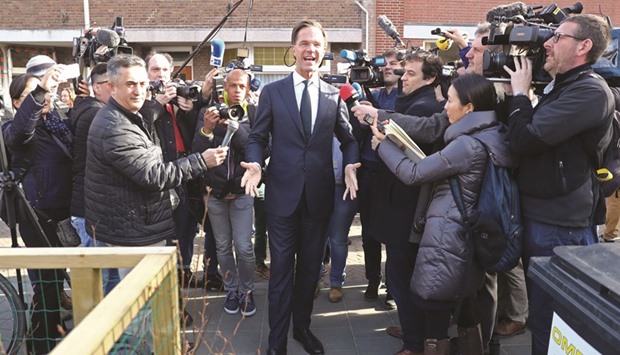
The Netherlands’ Prime Minister Mark Rutte arrives to cast his ballot at a polling station in The Hague.