


A dollar pullback ahead of an all-but-certain US interest rate rise allowed emerging equities and currencies to post modest gains yesterday, while the Indian rupee outperformed for the second day, racing to new 16-month highs.
With futures pricing in more than a 90% chance the US Federal Reserve would raise rates later in the day, investors are instead focused on what it says about the pace of hikes for the rest of the year.
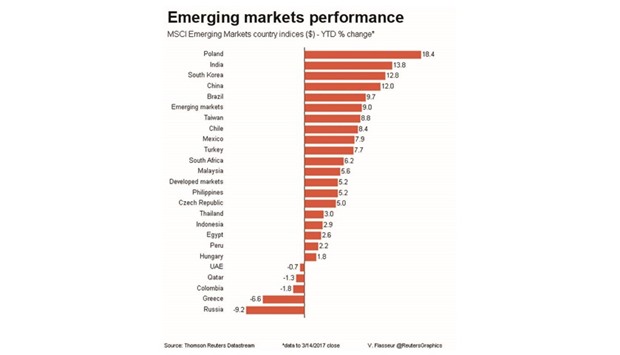
Emerging markets have eased off 19-month highs on growing expectation the Fed will raise rates more than twice this year, but they are being cushioned by better domestic growth and company earnings alongside global investors’ desire for yields.
MSCI’s emerging equity index inched up 0.2%, trading just off two-week highs for their fourth day of gains while currencies were flat to around 0.3% firmer against the greenback.
“The main question is really regarding the rhetoric....the market is pricing in something like 2.5 to 3 rate hikes this year, so if there is any risk that it could be more dovish then this could be positive for emerging markets,” Credit Agricole strategist Guillaume Tresca said.
Tresca noted big flows into emerging assets this year, with EPFR Global-tracked equity funds receiving $6.5bn year-to-date and local currency emerging debt funds last week seeing their biggest inflow in nine weeks. “(Inflows) have been steady year-to-date and even over the past weeks whatever the expectations regarding the Fed interest rates — so it seems markets were not really worried by the Fed,” he added.
The lira firmed to five-day highs against the dollar, even though the Turkish economy’s dire state was highlighted by data showing unemployment near seven-year highs and a rise in inflation forecasts for the end of the year.
Confidence about any impact of a Fed move was also reflected in primary emerging bond markets, which saw Kuwait raising $8bn on Tuesday, taking almost $30bn in orders, while Lebanon and Russian sub-sovereign Gazprom prepared new issues.
The five-year tranche’s yield tightened further to 2.78% from Tuesday’s 2.85% and 2.88% at issuance while the 10-year bond, issued at 3.62%, tightened to 3.52%.
In central Europe, the Polish zloty, which has been under pressure amid expectations for eurozone rate hikes from 2018, slipped 0.2% to the euro.
Analysts reckon the central bank will hold off rate rises despite data showing above-forecast inflation in February.
“It remains to be seen how relaxed central European central banks will remain as core inflation keeps moving higher, even if gradually.
For the moment, Poland (central bank) is likely to remain wholly dovish,” ING analysts told clients.
In Uzbekistan, there were some signs authorities may be mulling modest currency reform — the sum currency has fallen sharply this week against the dollar and rouble in official as well as black markets.
.