


European companies can ban employees from wearing religious or political symbols including the Islamic headscarf, the EU’s top court ruled yesterday in a landmark case.
The European Court of Justice (ECJ) said that it does not constitute “direct discrimination” if a firm has an internal rule banning the wearing of “any political, philosophical or religious sign”.
The Luxembourg-based court was considering the case of a Muslim woman fired by the security company G4S in Belgium after she insisted on wearing a headscarf.
Rights group Amnesty International said the ECJ action was “disappointing” and would only encourage discrimination.
“By ruling that company policies can prohibit religious symbols on the grounds of neutrality, they have opened a back door to precisely such prejudice,” Amnesty said in a statement.
The wearing of religious symbols, and especially Islamic symbols such as the headscarf, has become a hot button issue with the rise of nationalist and sometimes overtly anti-Muslim parties across Europe.
Some countries such as Austria are mulling a complete ban on the full-face veil in public while in France last year local authorities barred women wearing the burkini (also spelt burqini), the full-body swimsuit, fining those who did.
French conservative candidate Francois Fillon hailed the ruling as “an immense relief” that would contribute to “social peace”.
Manfred Weber, head of the centre-right European People’s Party, the biggest in the European Parliament, welcomed the ECJ finding as a victory for European values.
“Important ruling by the European Court of Justice: employers have the right to ban the Islamic veil at work. European values must apply in public life,” Weber said in a tweet.
A campaign group backing the women said the ruling could shut many Muslim women out of the workforce.
And European rabbis said the ECJ had added to rising incidences of hate crime to send a message that “faith communities are no longer welcome”.
The ECJ was ruling on a case dating to 2003 when Samira Achbita, a Muslim, was employed as a receptionist by G4S security services in Belgium.
At the time, the company had an “unwritten rule” that employees should not wear any political, religious or philosophical symbols at work, the ECJ said.
In 2006, Achbita told G4S that she wanted to wear the Islamic headscarf at work but was told this would not be allowed.
Subsequently, the company introduced a formal ban.
Achbita was dismissed and she went to court claiming discrimination.
The ECJ said that European Union law does bar discrimination on religious grounds, but G4S’s actions were based on treating all employees the same, meaning no one person was singled out for application of the ban.
“The rule thus treats all employees of the undertaking in the same way, notably by requiring them, generally and without any differentiation, to dress neutrally,” the ECJ said. “Accordingly, such an internal rule does not introduce a difference of treatment that is directly based on religion or belief.”
However in a related case in France, the ECJ ruled that a customer could not demand that a company employee not wear the Islamic headscarf when conducting business with them on its behalf.
Design engineer Asma Bougnaoui was employed full-time by Micropole, a private company, in 2008, having been told that wearing the headscarf might cause problems with clients.
Following a customer complaint, Micropole asked Bougnaoui not to wear the headscarf on the grounds that employees should be dressed neutrally.
She was subsequently dismissed and went to court claiming discrimination.
The ECJ said the case turned on whether there was an internal company rule in place applicable to all, as in the G4S instance, or whether the client’s demand meant Bougnaoui was treated differently.
The ECJ concluded that Bougnaoui had indeed been treated differently and so the client’s demand that she not wear a headscarf “cannot be considered a genuine and determining occupational requirement”.
The Open Society Justice Initiative, a group backed by the philanthropist George Soros, said that the ruling “weakens the guarantee of equality” offered by EU non-discrimination laws.
“In many member states, national laws will still recognise that banning religious headscarves at work is discrimination,” policy office Maryam Hmadoun said. “But in places where national law is weak, this ruling will exclude many Muslim women from the workplace.”
Amnesty International welcomed the ruling on the French case that “employers are not at liberty to pander to the prejudices of their clients”.
But, it said, bans on religious symbols to show neutrality opened “a backdoor to precisely such prejudice”.
The president of the Conference of European Rabbis, Chief Rabbi Pinchas Goldschmidt, complained: “This decision sends a signal to all religious groups in Europe.”
National court cases across Europe have included questions on the wearing of Christian crosses, Sikh turbans and Jewish skullcaps.
In the Belgian case, the ECJ said: “An internal rule of an undertaking which prohibits the visible wearing of any political, philosophical or religious sign does not constitute direct discrimination.”
It was for Belgian judges to determine whether she may have been a victim of indirect discrimination if the rule put people of a particular faith at a disadvantage.
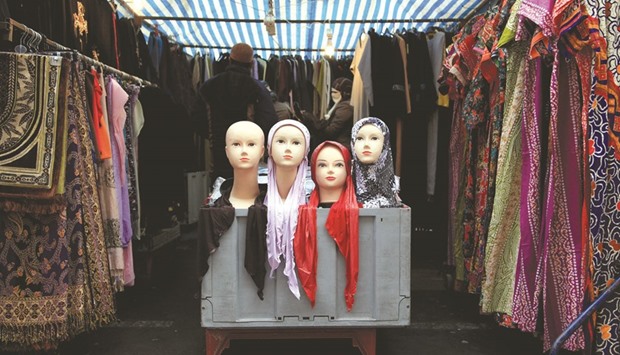
This file picture taken in east London shows people at a market stall selling the hijab.