


Russia said yesterday it hoped its anti-doping body RUSADA would have its suspension lifted in November, but the World Anti-Doping Agency said it still had “significant work” to do.
Sports minister Pavel Kolobkov said Russia would “work diligently” towards a clean culture and listed what he said was progress on restructuring its anti-doping system after years of cheating scandals across a wide range of sports.
“We are open for all kinds of inspections of individual athletes and organisations such as RUSADA,” he told an international meeting in Lausanne, Switzerland. “We are ready to pass any kind of external inspection.”
A series of reports by the world agency, WADA, have found that Russia conducted rampant state-sponsored doping, and led to the country’s track-and-field federation being barred from last year’s Olympics in Rio de Janeiro.
The vast majority of Russian competitors also seem certain to miss the World Athletics Championships in London in August.
WADA president Craig Reedie said RUSADA, suspended in 2015, for systematically breaking anti-doping rules, had taken steps forward in the past year, but more were needed.
“There remains significant work to do. (RUSADA) must demonstrate its processes are autonomous and independent from outside interference,” Reedie told the Lausanne meeting.
In a reminder of the continuing fallout from the scandal, the Swiss-based Court of Arbitration for Sport (CAS) yesterday upheld a lifetime ban on Sergei Portugalov, former chief of the Russian Athletics Federation’s Medical Commission, for his role in providing illicit substances to Russian competitors.
In a 2015 report, WADA had written that Portugalov supplied performance-enhancing drugs to athletes and coaches, administered doping programmes and “even injected athletes himself”.
‘INHUMAN’
Kolobkov, a former Olympic gold medal-winning fencer, was at times conciliatory, at times defiant. He described the Rio track-and-field ban as a “tragedy”, and Russia’s exclusion from the Paralympics in the Brazilian city as “simply inhuman.”
“Clean athletes should not be deprived of the chance to take part in competition at any level as this contradicts the ideals of sports,” he said.
Russian President Vladimir Putin earlier this month denied state-sponsored doping but acknowledged there had been individual instances of cheating that indicated the country’s current system was not working.
“The ball is in their camp and we will see when they will be able to deliver this programme,” WADA Director General Olivier Niggli said.
He described Putin’s comments as “very encouraging, going in the right direction”.
“I hope that politics can now stay at the door and we can all focus on protecting clean sports and clean athletes,” Niggli said.
A WADA-commissioned report by Canadian law professor Richard McLaren found state-backed doping involved more than 1,000 Russian athletes.
McLaren told the meeting: “(The) state sponsor from a Russian perspective is Putin and the inner circle.
“The evidence we have is up to the sports minister. It stops there,” he said, referring to Kolobkov’s predecessor Vitaly Mutko.
“Institutional or not, there are many words you can use... What we had was a conspiracy involving Russian officials.”
US anti-doping chief says WADA is ‘fox guarding hen house’
The World Anti-Doping Agency (WADA) is not an independent body and in its current state cannot police sport as it lacks the powers of a global regulator, US Anti-Doping Agency chief Travis Tygart said.
Speaking to Reuters during a WADA meeting in Lausanne, Switzerland, Tygart said as long as sports bodies were represented on WADA, the anti-doping organisation could not deliver on its promise to crack down on cheats. “It is the fox guarding the hen house,” Tygart told Reuters when asked whether WADA was independent. “Clearly not. No question about it.” WADA has been in the spotlight since 2015 over a Russian state-backed doping scandal that involved more than 1,000 athletes and led to the suspension of the country’s athletics federation and its anti-doping agency.
Russia’s track and field athletes were banned from last year’s Rio de Janeiro Olympics but the International Olympic Committee refused to exclude its entire Olympic team, despite being urged to do so by WADA. WADA’s foundation board and executive committee are composed equally of representatives from the Olympic movement and governments.
“We have to get clear first what WADA’s role is. It has to be that of a global regulator and then we can see what it costs to fund this,” Tygart said.
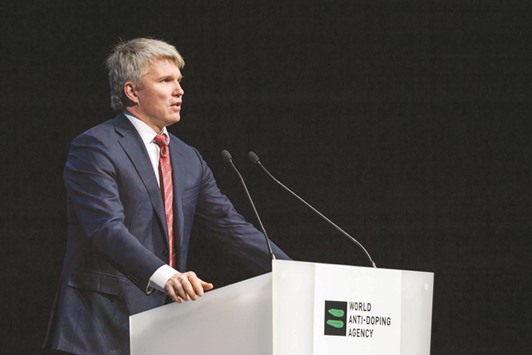
Russian Sport Minister Pavel Kolobkov addresses the assembly at the opening of the 2017 edition of the World Anti-Doping Agency (WADA) Annual Symposium in Lausanne yesterday. (AFP)