


Eurozone manufacturing growth accelerated to a six-year high in February as a weaker euro helped drive strong demand for its exports, with inflationary pressure showing further signs of recovering, a business survey showed.
While the upturn in eurozone factory activity was not shared by all major economies, particularly France, prices rose faster across most countries in the region.
The IHS Markit eurozone manufacturing Purchasing Managers’ Index rose to 55.4 in February — the highest reading since April 2011 — from 55.2 in January, although it inched down from a flash estimate of 55.5.
That reading is well above the 50 mark denoting growth and suggests a solid pickup in activity.
Optimism among Eurozone manufacturers about future business is also surging.
An index measuring output, which feeds into a composite PMI due out on Friday, jumped to 57.3, which was also the highest in nearly six years.
The flash composite PMI suggested economic growth of 0.6% in the first quarter.
Separate data showed German unemployment fell more than expected in February, with the jobless rate holding at 5.9%, the lowest since German reunification in 1990.
Renewed optimism about the region’s economic outlook in recent weeks has been buoyed by a weak euro, which makes the currency bloc’s exports relatively cheap on world markets.
The latest PMI survey’s new export orders sub-index rose to its highest since April 2011 at 55.5, up from 55.2 in January.
The euro is predicted to weaken a further 3% against the dollar over the coming year, according to a recent Reuters poll of foreign exchange analysts.
Brisker exports and the fastest growth in prices charged in nearly six years will be welcome news for the European Central Bank, which is widely expected to remain on the sidelines through upcoming elections in key countries in the region.
In Britain, manufacturing activity eased more than expected in February but still showed relatively solid expansion.
It remains far from clear whether the latest upswing in Eurozone activity will last, however.
Possible upsets in those elections, in the Netherlands, France and Germany, along with a rise in protectionism worldwide, pose the biggest risks to the Eurozone economy, according to a recent Reuters poll of economists.
Meanwhile, Asian factories extended a global manufacturing revival as activity picked up steam in February, though the outlook for many of the region’s export-reliant economies remained uncertain in the wake of US President Donald Trump’s protectionist stance.
Manufacturing surveys for Asia, including for its two biggest economies China and Japan, showed a broadly positive impulse for exports in a welcome sign for many of the companies tapped into the global supply chain. “Encouragingly, the data indicated that the current upturn in demand remains broad-based across both domestic and international markets, while a further steep increase in purchasing activity raises the prospect of continued production growth in coming months,” said Annabel Fiddes, economist at IHS Markit, referring to Taiwan’s strong PMI reading.
Trump, however, remained the great unknown risk factor for Asia and the rest of the world.
In a key speech to Congress, the US president outlined his plan for his first year in office that included healthcare and tax reforms, but he did not announce anything new on trade.
Trump’s protectionist stance has rattled global markets, with policymakers and investors remaining on edge until they see more clarity, and specific details, on US economic policies.
Authorities in China, whom Trump last week labelled the “champions of currency manipulation”, can take comfort from a private survey showing factory activity expanded for an eighth consecutive month thanks to a pick up in export orders.
Zhou Hao, an economist at Commerzbank expects “bubble deflating” will remain a key theme at the upcoming National Congress, underscoring challenges for policymakers in China as an explosive rise in debt in recent years has stoked speculative asset bubbles.
That explains why Beijing plans to slightly lower its target for broad money supply growth to 12%, as authorities adopts a modest tightening bias in a bid to cool strong credit growth.
It raised interest rates on a key funding tool in January.
India also benefited from a rebound in global demand with activity expanding for a second month, not entirely surprising given data a day earlier showed annual growth expanded 7%, though the strong number raised scepticism among economists on the quality of the figures.
Of greater concern was the rate of increase in output prices, as a sub-index measuring costs paid by customers grew at its fastest pace in nearly three and a half years in a sign of rising inflationary pressures.
The encouraging factory activity in Asia should also be squared off against rising interest rates in the United States, where any tempering in activity could prove detrimental to some of the region’s globe-trotting manufacturers.
A handful of Federal Reserve policymakers on Tuesday jolted markets into higher expectations for a March US interest rate increase, with comments that suggested rate-setters were worried about waiting too long in the face of pending economic stimulus from Washington.
Similar surveys later in the day are expected to show solid growth in manufacturing in Europe and the United States.
China’s exports, which have lagged its regional counterparts in recent months, showed signs of a pickup with the Caixin PMI sub-index for new export orders rising to 53.8, the highest rate of growth since September 2014.
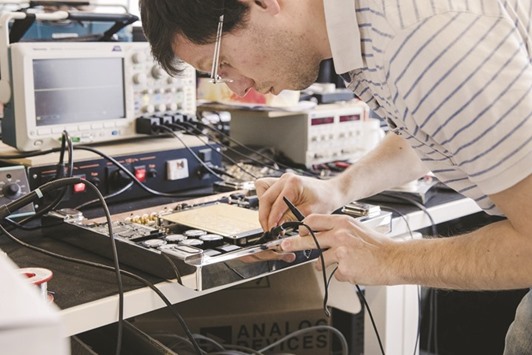
An engineer connects a Devialtet amplifier to an oscilloscope at the Analogue Digital Hybrid amplification technology company’s headquarters in Paris. The IHS Markit eurozone manufacturing Purchasing Managers’ Index rose to 55.4 in February u2014 the highest reading since April 2011 u2014 from 55.2 in January, although it inched down from a flash estimate of 55.5.