


Just weeks after stepping down as German foreign minister, Frank-Walter Steinmeier was elected yesterday to become the nation’s president by an overwhelming majority of a special constitutional assembly, despite the vote falling short of expectations.
Steinmeier, 61, secured 931 votes of the 1,239 votes cast in a secret ballot for the largely ceremonial post of president at a meeting of the Federal Convention.
However, the vote for Steinmeier was lower than what had been expected, with 103 convention members abstaining in the vote.
This points to possible frustration with the leadership of Chancellor Angela Merkel within the ranks of her conservative Christian Democrats (CDU) and their Bavarian-based allies, the Christian Social Union (CSU).
The CDU-CSU and the junior member of the Merkel-led coalition – Steinmeier’s centre-left Social Democrats (SPD) – had a combined convention vote of 923 national and state lawmakers in the assembly, which has a total of 1,260 members.
Members of the pro-business Free Democrats (FDP) and the environmentalist Greens were also expected to support Steinmeier, bringing the expected vote for the former foreign minister to more than 1,000.
A candidate needed to secure 631 convention votes to win.
“We live in turbulent times; people are uncertain,” Steinmeier said in his acceptance speech.
But he said that Germans should take a sense of pride from their nation having become “an anchor of hope for many in the world”.
“Let us be courageous, then. At any rate, I am not afraid of the future,” Steinmeier said.
Merkel said Steinmeier would be an excellent president.
“He is a man with the common touch,” she said.
“I trust him to accompany our country very well through these difficult times,” the chancellor said.
Italian Prime Minister Paolo Gentiloni also weighed in on the pick via Twitter.
“Happy at the election of Frank-Walter #Steinmeier as president of the German republic,” Gentiloni tweeted. “This is good news for Italy and for Europe.”
In his remarks opening the special assembly, the president of the German Parliament warned US President Donald Trump against leading that country into isolation.
“Whoever calls for cutting themselves off instead of pursuing an openness to the world should not be surprised if others do the same,” said Norbert Lammert.
He criticised Trump’s calls to put “America first” and accused him of “preaching” isolationism instead of promoting co-operation.
But after describing Trump as “a hate preacher” during the US presidential election, Steinmeier told German public TV that he was open for talks with the US leader.
“Of course, you have to accept the possibilities of talks when they present themselves. That’s why we’re have to look at how we’re going to deal with the American president,” Steinmeier said after his election.
Steinmeier will next month replace Joachim Gauck, a 77-year-old former East German pastor and human rights activist, who steps down next month as head of state at the end of his five-year term.
Regularly voted in opinion polls as the nation’s most popular politician, Steinmeier faced four other candidates in the election for the post.
First convened in 1949, the convention draws its members from the world of German entertainment, sport and culture.
This year it included: the trainer of the nation’s football team, Joachim Loew; drag queen Olivia Jones; and Semiya Simsek Demirtas, whose father was the first victim of an alleged neo-Nazi terrorist group the National Socialist Underground (NSU).
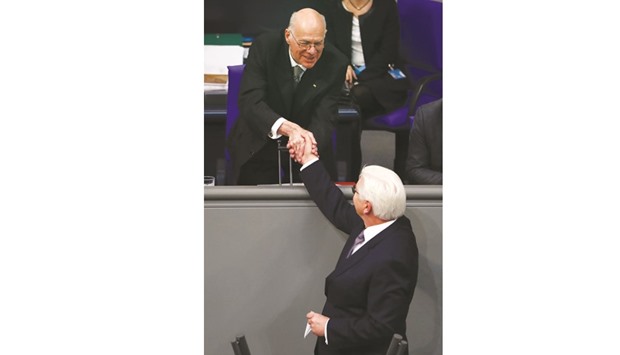
Steinmeier is congratulated by the president of the Bundestag (lower house of parliament) Norbert Lammert (above) after the presidential election in Berlin.