


Of all the times you thought of moving forward in your fitness routine, did you ever think that the answer could lie in something as simple as moving backward? Retro Walking, or Backward Walking, has been catching the fancy of people across the world, and it’s all set to hit Qatar now.
The driving idea behind California Tortilla Reverse Walk–Rewind the Pain, in association with Qatar Diabetes Association, was to find a way to promote good health as well as raise awareness to health issues while “contributing to doing good to and for local charities”. The Reverse Walk event, which is also partnered by Qatar Foundation, will be held at Aspire Park on March 3, from 3pm to 7pm. And the news itself might be a cue for you to include reverse walking into your fitness regimen.
Known by many names such as retropedalling, retro walking, backward walking, walking backward as well as retro motion, reverse walking is said to have originated in ancient China, where it was practised for good health. In the modern world, it’s become quite the rage in Japan, China and parts of Europe, where people use it to build muscle, improve sports performance, promote balance and more, says a note by Reverse Walk, an initiative founded by four companies; Nehmeh, Roots, Exoda, and Makyna.
So what exactly does reverse walking do? “The muscles of the front (tibialis anterior) and back (gastro/achilles) of the shin and ankle are strengthened, owing to the increased strain of performing an unfamiliar exercise. Walking backward increases cardiovascular endurance significantly more than walking forward under the same conditions. We expend more energy and burn more calories than those who work out at the same pace consistently for a longer duration. When engaging in a new activity which requires a greater effort, we exert ourselves more. The increased metabolism will result in weight loss for those who press on,” says Reverse Walk about the benefits.
Much like reverse lunges, walking backwards is said to put less stress on the knee joint compared with walking or running forward. Studies have shown that using other muscle groups by performing different exercises protects our muscles and tendons from overuse. The knee joint and the patella joint (the joint where the kneecap glides on the knee), in particular, benefit from backward walking.
“Adding a new activity to our regular exercise routine prevents boredom, so we are less likely to stop exercising. For those over 50, improving our balance and co-ordination is even more important. Backward locomotion improves the functions of our cerebellum which co-ordinates and balances our bodily movements as well as flexibility. Because we are on the constant lookout for danger and obstacles on our path, practically all of the five senses (and even the sixth) are sharpened. Our reflexes are sharpened at the same time. It can help prevent the development of a hunchback. It promotes blood circulation and prevents lumbago,” says Reverse Walk.
As part of a few testimonials put together by Reverse Walk, sportsman Ziad al-Darwish says, “When you walk backwards it gives you a chance to work out all of those muscles in your legs, such as your quadriceps and calves, which take a backseat to your hamstrings during regular walking. Reverse Walk also works out my hamstrings in a different way and increases their flexibility.”
Executive professional Melissa Estrada says, “People do look at me funny but when I walk backwards, it actually puts less strain and requires less range of motion on my knee joints, making it ideal for people like me, who have knee problems or injuries. Also, I take my little baby in her stroller without worries.”
Elaborating on the benefits of reverse walking, Dr Joseph Mercola, on his website Mercola, says, that since backward walking eliminates the typical heel-strike to the ground (the toe contacts the ground first), it can lead to changes in pelvis alignment that help open up the facet joints in your spine, potentially alleviating pressure that may cause low back pain in some people.
“Interestingly, when you walk backwards, your heart rate tends to rise higher than it does when walking forward at the same pace, which suggests you can get greater cardiovascular and calorie-burning benefits in a shorter period of time,” Dr Mercola points out. “There appear to be benefits for your brain, too. Researchers found that when you walk backwards, it sharpens your thinking skills and enhances cognitive control. This may be because even though backward walking is a physical activity, it’s also a ‘neurobic’ activity, meaning it requires brain activity that may help you stay mentally sharp. Plus, since it puts your senses into overdrive as you move in an unfamiliar way, it is also known to enhance vision as well.”
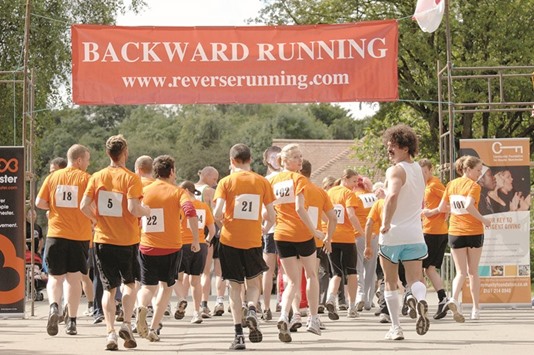
Much like reverse lunges, walking backwards is said to put less stress on the knee joint compared with walking or running forward. Photo by Caravanum/Flickr