


The government does not have “a blank cheque” to push through its vision of Brexit, Jeremy Corbyn has said, despite the overwhelming Commons vote to pass the article 50 bill without a single amendment.
The Labour leader said there was little his party could have done about the bill, given its limited scope, but said he would continue to push for concessions and changes as the Brexit process continued. “There was a referendum,” he told BBC1’s Breakfast programme. “There was a decision by the people of this country and we support the result of the referendum, and have to carry it out.
“It doesn’t mean we agree with the government on the economy for the future. It does mean we have to build good relations with everybody across Europe.”
Insisting the government had already made concessions over both the fact of the article 50 bill, and over a parliamentary vote on a final Brexit deal, Corbyn said there was scope to shape the process.
“The government does not have a blank cheque to set up an offshore tax haven in Britain,” he said. “All that it has is authority to proceed with negotiations, which is what the referendum was about.”
The bill was passed overwhelmingly, by 494 votes to 122, and will now pass to the House of Lords, where Labour and Liberal Democrat peers will press for concessions on key issues including the status of EU citizens living in the UK.
Ministers will place significant pressure on peers not to obstruct or amend the bill, even threatening this could otherwise see the end of the upper chamber in its current form. A government source said: “If the Lords don’t want to face an overwhelming public call to be abolished they must get on and protect democracy and pass this bill.”
Clive Lewis, the shadow business secretary, resigned after deciding to go against the three-line whip. He became the fourth shadow cabinet member to step down rather than vote in favour.
Corbyn denied it meant there was a crisis in Labour over the issue. “It’s not a disaster,” he said. “The majority of Labour MPs voted to trigger article 50. Fifty-odd voted against it, mainly on the basis of a strong message from their own constituents. On all the other votes there is unity, on all the other campaigning there is unity.”
Asked about his statement in a tweet that the “real fight” for Brexit starts now, Corbyn argued there was little that could have been achieved with the article 50 bill. “Do you not understand - this was a one-clause bill,” he said. “A one-clause bill that authorised the government to start negotiating, and recognised the result of the referendum.”
There was, however, anguish among some Labour MPs about amendments not being passed. Harriet Harman, who had proposed guarantees for overseas EU nationals in the UK, said the failure of this meant these people were being used as “human shields” for Brexit negotiations.
“There’s now going to be months if not years of uncertainty; we could have ended that. There’s clear evidence that gangmasters are exploiting people,” she said.
The bill’s passage through the Commons was welcomed by Brexit supporters. Former Ukip leader Nigel Farage, who campaigned for decades for an EU referendum, said: “I never thought I’d see the day where the House of Commons overwhelmingly voted for Britain to leave the European Union.”
David Davis, the Brexit secretary, said: “We’ve seen a historic vote tonight — a big majority for getting on with negotiating our exit from the EU and a strong, new partnership with its member states.”
Lewis was one of 52 Labour MPs who rebelled against Corbyn’s three-line whip to vote against the legislation, which authorises the government to trigger article 50, the formal process for exiting the EU.
Lewis represents Norwich South, a constituency that voted strongly to remain in the EU, and had been openly agonising about whether he could bring himself to support the legislation.
“When I became the MP for Norwich South, I promised my constituents I would be Norwich’s voice in Westminster, not Westminster’s voice in Norwich,” Lewis said. “I therefore cannot, in all good conscience, vote for something I believe will ultimately harm the city I have the honour to represent, love and call home.
“It is therefore with a heavy heart that I have decided to resign from the shadow cabinet.”
Widely seen as a rising star on the left of the party, Lewis voted for the bill at its second reading last week, but made it clear that if Labour failed to amend the legislation he could not do so again. When the last potential amendment failed on Wednesday night, Labour issued a statement saying he had stepped down.
Some see him as a potential leadership candidate, who could act as a bridge between the Corbynite wing of the party, and the so-called soft left. But in the corridors MPs were being quite disparaging about what some called his “flip-flopping” in recent days about whether he could back the bill.
Diane Abbott, the Hackney North MP who was absent from last week’s second reading, citing a migraine, voted in favour of the bill, despite speculation that she was concerned about the reaction of her pro-remain constituents.
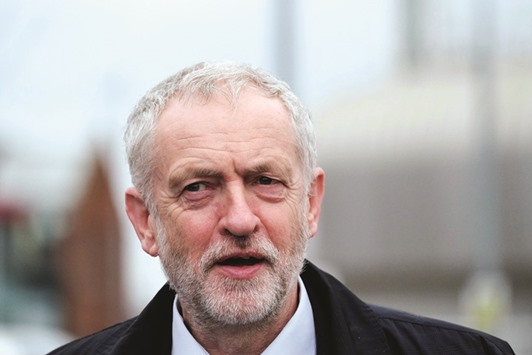
Jeremy Corbyn ... scope for negotiation.