


Indian shares climbed after the government’s federal budget maintained the status-quo on tax breaks for equity investments, allaying investor concerns. The benchmark Sensex had its biggest budget-day gain since at least 2006 and closed at the highest level since October.
The BSE Sensex closed up 485.68 points, or 1.76%, to 28,141.64 points yesterday.
Eighteen of the 30 Sensex members advanced as Maruti Suzuki India, India’s biggest carmaker by sales, rose 4.8% to a record closing price. Tata Consultancy Services dropped 2.8%, leading a second day of decline for software exporters, on concerns that the change in US work visa rules will increase wage costs and narrow profit margins.
“The market cheered the budget speech as it didn’t have any negatives that were expected, such as dilution in tax exemptions for equity investors,” said Sushant Kumar, a fund manager at Mumbai-based RAAY Global Investments. “Short covering pulled” it up, according to Kumar.
The S&P BSE India Realty Index, a gauge of 10 property developers, rose the most since March 2016 on budget proposals such as a boost for affordable housing projects. The index advanced the most among 13 sector gauges compiled by BSE. The S&P BSE Information Technology index dropped the most, extending two-day decline to more than 4%.
“Affordable housing developers will now be eligible for several government incentives, subsidies, tax benefits and most importantly institutional funding,” said Neeraj Bansal, a partner at KPMG in New Delhi.
The Sensex capped its best gain last month since July 2016 as overseas investors bought a total $293mn of local shares in each of the last two weeks, the first such successive purchase since October 7.
“Unchanged taxes and strong fiscal-deficit target in the budget will lead to foreign investors entering fresh longs or annulling their shorts,” said Nikhil Khandelwal, managing director of institutional equities at Mumbai-based Systematix Shares & Stocks. The budget will boost consumer demand in rural India, “a big positive” for consumer staples and discretionary companies, according to Khandelwal.
Bharat Financial Inclusion (BHAFIN) +8.9%, Mahindra Financial (MMFS) +7.2% are top gainers on BSE 200 index; boost to affordable housing is positive non-bank finance companies, Angel Broking Chairman Dinesh Thakkar says.
InterGlobe Aviation (INDIGO) -7.4% after net income surprisingly dropped.
Meanwhile the rupee closed 0.57% stronger, the maximum in eight months, against the US dollar yesterday, after finance minister Arun Jaitley announced a fiscal deficit target that was in line with estimates. This is the sixth consecutive session when the rupee closed higher.
The home currency closed at 67.48 — a level last seen on December 14, 2016, up 0.58%, biggest gains since May 25, 2016, from its previous close of 67.87. The local currency opened at 67.61 a dollar, and touched a high and a low of 67.48 and 67.68 respectively.
The finance minister has announced a fiscal deficit target of 3.2% for the financial year 2017-18 up from the goal of 3% set earlier. Analysts had estimated 3-3.3% fiscal deficit target.
“Overall, the government’s decision to stick to fiscal consolidation — despite the growth hit caused by demonetisation and the upcoming state elections — is a positive signal”, Nomura India chief economist Sonal Varma said in the note.
The recent rally in the rupee was also due to continued buying from foreign institutional investors (FIIs) in the local equity markets. FIIs bought nearly $451mn in equity over the last nine trading sessions and have been buyers on all but one trading session during this period.
The finance minister announced less-than-estimated borrowing programme at Rs3.48tn via bonds in FY18 versus Rs4.25tn last years budgeted.
“Additional entry in this budget which specifically provides for buyback of securities by the government is the source of confusion with regard to net borrowing numbers,” said Edelweiss Securities in a note to its investors.
However, the finance ministers figure is net of not only redemption’s in the year but also nets out the buyback of Rs75,000 crore pencilled in for FY18, which has not been the practice so far. On similar lines, the govt has undertaken buyback of Rs60,000 crore in the current financial year as well, which brings down the net borrowing for FY17 to Rs 3.47tn, Edelweiss said.
“So in terms of comparable numbers for the two years, the net borrowing is quite similar and so the markets should not be too disappointed or overly euphoric with the borrowing targets,” Edelweiss Securities note added.
India’s 10-year bond yield closed at 6.431% compared to its Tuesday’s close of 6.407%. Bond yields and prices move in opposite directions.
Since the beginning of this year, the rupee has gained 0.67%, while FIIs have sold $6.4mn in local equity and $382.40mn in debt markets.
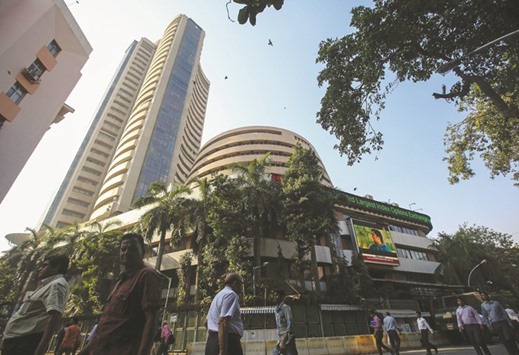
People walk by the Bombay Stock Exchange building in Mumbai. The BSE Sensex closed up 485.68 points to 28,141.64 yesterday.