


African Union (AU) leaders chose Chad’s candidate to chair the 54-nation body yesterday at a summit where the divisive issues of Africa’s relationship to the International Criminal Court (ICC) and Morocco’s readmission to the AU were on the agenda.
In the last round of voting, Chadian Foreign Minister Moussa Faki Mahamat beat Kenya’s top diplomat Amina Mohamed to secure the post as head of the commission of the AU, which is headquartered in the Ethiopian capital.
A Chadian official told a group of reporters that his nation’s candidate had secured 39 votes in the final round.
Faki, born in 1960, has served as foreign minister since 2008.
In a race usually resolved in behind-the-scenes talks before a summit vote, three of the AU’s four major regions vied for the post – the south, the east and the largely Francophone west – with some regions pushing more than one candidate.
Outgoing commissioner, South Africa’s Nkosazana Dlamini-Zuma, stayed in post an extra six months after leaders failed to agree a candidate in July.
She is now tipped as a contender to succeed her ex-husband, Jacob Zuma, as South Africa’s president.
As Chad’s foreign minister, Faki has been at the forefront of the fight against Islamists in Nigeria, Mali and the Sahel, raising his profile at home and abroad.
The election of the 56-year-old to the post of chairman of the AU Commission will likely signal a return to a focus on peace and security not seen under his predecessor Dlamini-Zuma.
South Africa-based analyst Liesl Louw-Vaudran of the Institute for Security Studies told AFP that Faki had run a “conventional campaign” rather than a slick social media heavy campaign like his main competitor from Kenya.
“We see a candidate emerging who is almost an old-style politician,” she said on the sidelines of the AU summit.
While Faki may focus more on peace and security, his own country’s track record may strike a blow to democratisation efforts on the continent.
Chadian President Idriss Deby was re-elected in 2016 for a fifth term in office amid massive opposition protests.
“I can’t see Moussa Faki Mahamat standing up when there is not a free and fair election,” Louw-Vaudran said.
Faki’s election comes as Deby hands over the rotating presidency of the AU, a sign the country has been able to impose itself within the bloc.
Chad has championed the fight against terrorism and is the headquarters of military operations against Boko Haram, as well as the French counter-terrorism operation in the Sahel, Operation Barkhane.
A loyal ally of President Idriss Deby from the same Zaghawa ethnic group, Faki has held a number of senior Chadian posts, including prime minister (2003-05), before being named foreign minister in 2008.
Fluent in French, Arabic and English, Faki studied abroad in Brazzaville and Paris.
As head of the AU Commission, he has said he dreams of a continent where the “sound of guns will be drowned out by cultural songs and rumbling factories” and wants “development and security” to top the agenda during his four-year term.
He also wants a less bureaucratic, procedural AU where free circulation of goods and people is made easier.
Preliminary meetings have also been dominated by disputes over the ICC, which countries such as South Africa and Kenya say is a tool of Western imperialism that unfairly targets the continent.
Conversely, Nigeria, Botswana and other states say The Hague-based court is an important legal backstop for countries whose justice systems have been compromised by civil conflict.
“You have all these calls for unity but actually if you look at the AU now, it is more divided than ever – over Morocco, the regional divisions and the ICC,” said Liesl Louw-Vaudran, an AU expert at the Institute for Security Studies in Pretoria. “It’s unprecedented.”
During Dlamini-Zuma’s time in charge of the AU, the medical doctor has focused on reforming the AU’s dysfunctional internal bureaucracy and drawing up a long-term plan for improving the lives of Africa’s underprivileged citizens, especially women and children.
However, she has been criticised for failing to heal the rifts created by her election and not doing more to prevent conflict in countries such as South Sudan, which the UN says is tilting towards genocide.
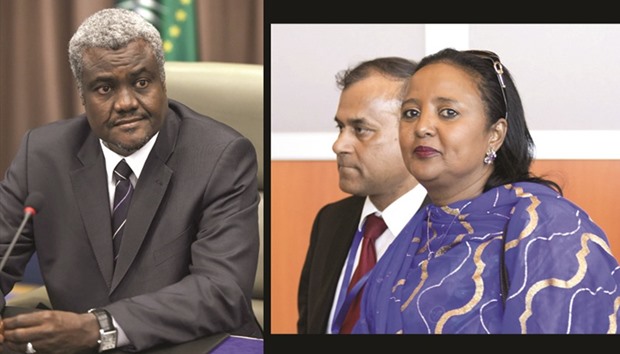
Faki (left) beat Kenya’s top diplomat Amina Mohamed (right) to secure the post as head of the commission of the AU.