


Italy’s €20bn ($21.4bn) government rescue fund is sufficient to recapitalise the country’s troubled banks, and about a third of money will be used for Banca Monte dei Paschi di Siena, Bank of Italy governor Ignazio Visco said.
“This measure is an important one for Italy as it emerges from the crisis that buffeted its economy and banking sector,” Visco, a member of the European Central Bank Governing Council, said on Saturday in a speech at the annual Assiom-Forex conference in Modena, near Bologna. “There is more than enough room to address the recapitalisation needs of any other Italian banks that meet the conditions laid down in the decree, in the first place those relating to the results of a stress test.”
Prime Minister Paolo Gentiloni’s government earmarked the fund last year to help recapitalise Monte Paschi and Italy’s other struggling lenders in an effort to revive a banking industry burdened with about €360bn of troubled loans and to boost credit. In a Paschi bailout that is slated to cost €8.8bn, Italy is using a provision that allows state support for solvent banks in exceptional circumstances.
“The measures taken in Italy in 2016 have made it possible to deal constructively with other crisis situations, with the contribution of both the public sector, including as a facilitator, and the private sector,” Visco said. Banks still need to reduce the amount of bad loans, even if the majority of lenders don’t need to “sell them immediately,” according to the governor.
The nation’s banking system is resilient, he said, and weaker banks should get rid of their bad loans and strengthen capital by raising fresh money on the market. The governor also urged medium-sized banks to merge “to achieve cost savings and increase operational efficiency.”
Meanwhile, the European Central Bank must maintain an accommodative stance on monetary policy to avoid deflation risks and ensure price stability, Visco said.
“There are as yet no clear indications of any inversion of trend in the core components driving developments in consumer prices and wage growth,” Visco, who sits on the European Central Bank Governing Council, said. “To bring inflation back to a path consistent with medium-term price stability, monetary conditions must continue to be highly accommodative.”
Euro-area inflation is heading toward the central bank’s mandate, Bundesbank President Jens Weidmann, who also sits on the ECB Council, said on Thursday in a speech. “Once price developments are sustained, they will provide the foundation for an exit from loose monetary policy,” Weidmann said. The ECB’s “expansionary monetary-policy path is currently appropriate” given the still-moderate inflation in the 19-country region, he added.
On the same day, Spain’s Prime Minister Mariano Rajoy expressed concern over a premature tightening of monetary policy by the ECB as the debate on when to exit quantitative easing intensified.
The ECB “greatly curtailed the risk of deflation and paved the way for a gradual return to monetary stability,” Visco said in Modena. He added that the December’s rise in inflation is “largely ascribable to the energy components” and “other highly volatile items.”
ECB President Mario Draghi reiterated last week that the risks to the euro-area recovery remain tilted to the downside and inflation is accelerating.
In his speech Visco also said Italy’s economy, the euro region’s third biggest, is “now, though slowly and laboriously, emerging” from a long crisis and in order to develop needs “stability and reforms.”
“There are no shortcuts, particularly for a country burdened with such a large public debt,” the governor said in a reference to a debt load that is more than 130% of Italy’s gross domestic product, the second largest by that measure in the 19-member bloc.
Italy’s GDP will expand 0.9% in 2017, unchanged from last year, the central bank forecast in a report last week. The Bank of Italy said there are downside risks from less favourable credit conditions, financial market tensions and any slowdown of reforms undertaken in the past years.
Earlier this month the International Monetary Fund cut its economic forecasts for Italy, saying growth this year will be limited to 0.7%.
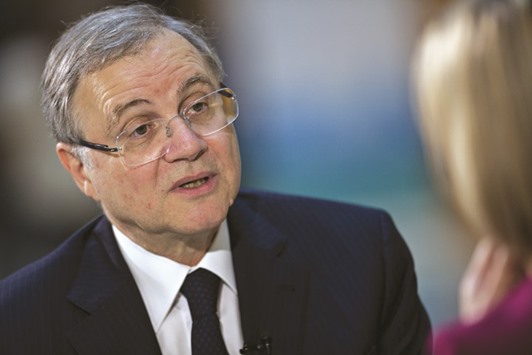
u201cThe measures taken in Italy in 2016 have made it possible to deal constructively with other crisis situations, with the contribution of both the public sector, including as a facilitator, and the private sector,u201d Visco said.