


An initial public offering from India’s BSE Ltd, the country’s second-biggest stock exchange, was well oversubscribed on the last day of the sale, helped by attractive valuations and expectations of robust growth for stocks in the coming years.
The IPO, which is seeking to raise Rs12.43bn ($182mn), saw bids for 51 times the number of shares on offer, data showed.
The strongest demand came from high net-worth individuals, who bid for 159 times the shares on offer, followed by institutional investors who bid for 48.6 times the shares allotted to them.
Although BSE is dwarfed by rival NSE in terms of trading volumes, Asia’s oldest exchange is still expected to benefit from a surge of retail investments into mutual funds and government efforts to steer more pension money into stocks.
The strong demand is also a good sign for NSE which last month submitted its own application for an IPO that could raise as much as $1bn.
“Financial markets are overall under-penetrated in India. As the working-age population increases, retail investor participation is expected to go up, and this can be a driver for the exchanges,” said Rahul Joshi, an analyst for Dion Global Solutions. “It will be a great story going ahead.”
More than 250 shareholders, including Singapore Exchange Ltd and billionaire George Soros’ Quantum, are selling up to 15.4mn shares in BSE, which was founded in 1875 under a banyan tree as Bombay Stock Exchange. That represents 28% of the company.
At its marketed price range of Rs805 to Rs806 per share, the exchange will have a market value of some Rs44bn.
Dion’s Joshi said its price-to-earnings valuation of 25.6 times for the year ended in March 2016 was in line with bourses such as Singapore Exchange and Deutsche Boerse even though it deserved to be much higher given its high growth potential.
BSE’s offering is the first IPO in India in 2017, after $4bn was raised in 2016, the best year in six. It will be listed on NSE as it is not allowed by law to list on its own exchange.
Although India’s ban last year of higher-value banknotes has hit market sentiment, retail investors have continued to pour into mutual funds, moving away from traditional savings such as gold and real estate – a trend analysts believe will last for years.
Financial firm SPA estimates equity savings as a portion of financial savings is only 5% in India compared to 14% in China, 20% in Indonesia, or 42% in the US.
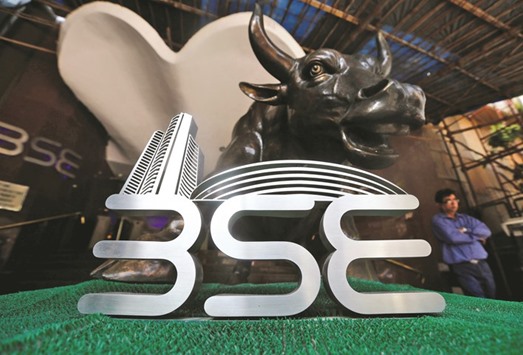
The BSE logo is seen at its building in Mumbai. An initial public offering from India’s second-biggest exchange was well oversubscribed on the last day of the sale, helped by attractive valuations and expectations of robust growth for stocks in the coming years.