


The dollar managed a small recovery against its major peers in Asia yesterday but retreated against most regional units after Donald Trump’s Treasury Secretary nominee said a strong currency could hurt the US economy.
Steve Mnuchin’s comments came as the new president pressed on with his protectionist rhetoric, withdrawing the US from the Trans-Pacific Partnership and threatening to impose border taxes, while also warning Beijing over its designs in the South China Sea.
The developments in Washington just days after Trump was sworn in have done little to ease investor worries that his plans to review trade deals and put Americans first could damage the global economy, particularly emerging markets.
Asian investors moved warily as they tried to gauge what the new administration intends to do.
Mnuchin, who has yet to be confirmed in his role, said Monday in a written response to a senator’s question about a 25% jump in the dollar: “From time to time, an excessively strong dollar may have negative short-term implications on the economy.” He also noted that it was currently “very, very strong”, Bloomberg News reported.
“The comments all but stuck a dagger into an already reeling greenback,” said Stephen Innes, a senior trader at OANDA.
The dollar tumbled against the yen, euro and even the pound despite continuing worries about Britain’s EU exit.
The greenback edged up against them Tuesday but was down against the Indonesian rupiah, Australian and Singapore dollars, Thai baht and Malaysian ringgit.
The unit is also well off highs hit earlier this month, after rallying since November on hopes Trump would enact pro-growth measures such as public works spending, lower taxes and regulatory reforms. He confirmed on Monday he plans to pursue those priorities. But markets have been worried about the lack of detail, while there is also concern about a possible trade war.
“The first couple of days of the new presidency have seen the rhetoric weighted toward protectionist policies while little detail is yet available on stimulus measures,” said Ric Spooner, Sydney-based chief analyst at CMC Markets Asia. “Unwinding free trade agreements and imposing border taxes is seen by markets as a negative for the dollar, which is not being helped by statements from the US Treasury secretary about it being overvalued.”
On equities markets Tokyo ended 0.6% down at 18,787.99 owing to the pick-up in the yen, while Shanghai closed up 0.2% at 3,142.55 and Seoul was flat.
Hong Kong closed 0.2% higher at 22,949.86 and Sydney added 0.7%.
Singapore and Taipei were slightly higher but Wellington and Manila retreated. In Seoul Samsung Electronics ended flat after it announced a 50% jump in net profit in October-December, despite the Galaxy Note 7 recall crisis that hammered its global reputation.
The tech giant said the gain was “driven by the components businesses, mainly the memory business and the display panel segment”, while the stronger US dollar also provided support.
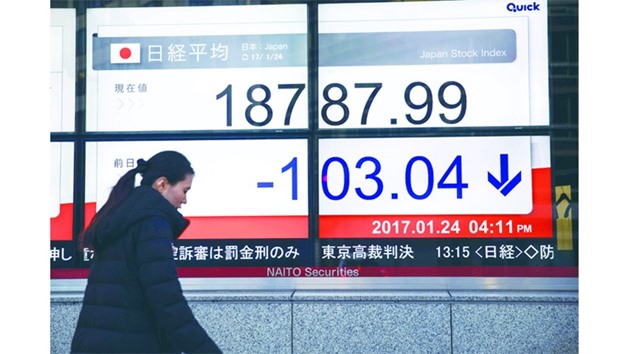
A pedestrian walks past an electronic quotation board flashing the Nikkei key index in Tokyo. Tokyo stocks slipped as exporters were hit by a yen rally, fuelled by concerns over President Donald Trump’s global trade plans and comments from his Treasury Secretary pick over a stronger dollar.