


France’s fractured Socialists were voting yesterday to choose a presidential candidate with the party in danger of being reduced to also-rans as Europe shifts to the right.
The two-round primary is viewed as a crucial test of the Socialists’ ability to re-invent themselves, with their outgoing flagbearer President Francois Hollande deeply unpopular after five years in office.
The presidential election in April and May is shaping up as a three-way battle between conservative former premier Francois Fillon, far-right leader Marine Le Pen, and Emmanuel Macron, the 39-year-old former economy minister who is stealing the headlines from his former Socialist government colleagues.
Most opinion polls currently show a Fillon-Le Pen run-off as the most likely scenario, with Macron possibly finishing ahead of the Socialist candidate in the first round but both being eliminated.
A poll published on Thursday gave Macron between 17% and 21% of the first-round vote.
Hollande’s former prime minister Manuel Valls, who resigned from the cabinet in December, was the favourite to win the Socialist nomination when the seven candidates began campaigning.
But many observers believe he has run a lacklustre campaign and two contenders from the party’s left flank – protectionist maverick Arnaud Montebourg and former education minister Benoit Hamon – will push him hard to reach next Sunday’s run-off.
Hamon has performed strongly in the three TV debates of a short campaign, attracting attention with his proposal to pay the poor and 18- to 25-year-olds a “universal income” rising from €600 to €750 ($640 to $800) a month – an idea dismissed as ruinously expensive by Montebourg.
“I voted for Benoit Hamon because to me he is the one best placed to revive the Socialist party,” said Jean Claude, who cast his ballot in Millau, southwestern France.
Dominique, a man in his 40s who voted in eastern Paris, said he was backing Valls.
“My main concern is that the left reaches the second round (of the presidential election). Valls is the most credible option against Macron,” he said.
Macron, a relative newcomer to politics who resigned from the government in August to set up his own centrist movement, has drawn large crowds to his campaign events in recent weeks.
Some Socialist heavyweights have hinted that they could support Macron over their party’s nominee if he looks to have a better chance of reaching the second round of the presidential election against Le Pen.
Le Pen, who leads the anti-immigration National Front (FN), told a meeting of right-wing populist parties in Germany on Saturday that Europe was about to “wake up” following the victory of Donald Trump in the US election and the British vote to leave the European Union.
Geert Wilders’ far-right party is forecast to perform strongly in March’s Dutch general election.
Macron himself has ruled out a pact with the Socialists, announcing on Thursday that his En Marche movement would field hundreds of candidates in parliamentary elections in June.
The Socialist primary has failed to energise voters who are hungry for change after economic stagnation under Hollande.
Turnout was markedly lower than in the centre-right Republicans primary last year, election officials said.
Polling stations close at 1800 GMT. Two hours beforehand, 1mn people had voted, according to figures from 70% of the polling stations.
At the same point in the Republicans’ primary that chose Fillon as the right-wing candidate, the figure was well over 2mn.
Communist-backed firebrand Jean-Luc Melenchon, who like Macron is polling in double digits in his campaign as an independent, also risks splitting the left-wing vote.
Valls, who was slapped this week by a protester, set out to modernise the party but has struggled to unite his camp, with his opponents accusing the former premier of betraying leftist ideals by forcing through labour market reforms.
The four other candidates running in the primary are former education minister Vincent Peillon, ecologist Francois de Rugy, ex-MEP Jean-Luc Bennahmias, and radical left candidate Sylvia Pinel.
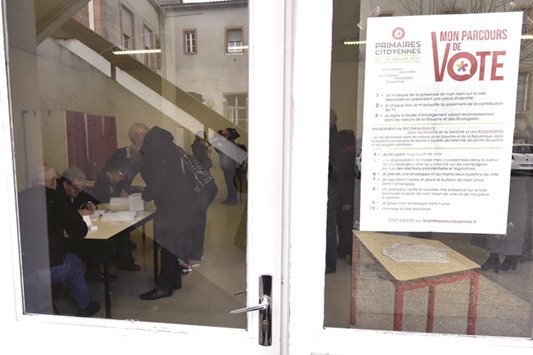
Instructions for voters are attached to the door of a polling station in Castelsarrasin, southern France, during the first round of the left-wing primary for the 2017 French presidential election.