


US President Barack Obama yesterday marked the first anniversary of the nuclear deal with Iran by emphasising its “significant and concrete results” and warning against undoing a pact supported by the world’s major powers.
In language that seemed clearly directed at incoming president Donald Trump, who is set to take office on Friday, a White House statement said “the United States must remember that this agreement was the result of years of work, and represents an agreement between the world’s major powers — not simply the United States and Iran.”
It said the deal had “achieved significant, concrete results in making the United States and the world a safer place” and “verifiably prevents Iran from obtaining a nuclear weapon.”
Such a diplomatic solution, it added, was “far preferable to an unconstrained Iranian nuclear programme or another war in the Middle East.”
Trump has often denounced the nuclear deal, and in a Sunday interview with the Times of London and Bild newspaper of Germany he continued his criticism, saying, “I’m not happy with the Iran deal, I think it’s one of the worst deals ever made.”
But he declined to say whether he intended to “renegotiate” the deal, as he asserted regularly during the presidential campaign.
The White House insisted yesterday that despite US reservations about other actions by Iran — including its support for “violent proxies” and “terrorist groups” — Tehran was upholding its nuclear commitments.
Iran, it said, had “reduced its uranium stockpile by 98% and removed two-thirds of its centrifuges.”
The White House stance was backed up by a statement from Secretary of State John Kerry, who helped negotiate the deal.
The agreement, Kerry said, had “resolved a major nuclear threat without firing a shot or sending a single soldier into combat. It was endorsed unanimously by the United Nations Security Council and earned the support of more than 100 countries across the globe.”
For all of Trump’s sharp criticism of Iran and the nuclear deal, his policy once in office remains unclear.
One of his top cabinet nominees, retired Marine general James Mattis, said last week that if he is confirmed as defence secretary, he will support the nuclear deal.
“When America gives her word,” he told senators during his confirmation hearing, “we have to live up to it and work with our allies.”
Mogherini says EU to stand by nuclear accord
EU foreign affairs head Federica Mogherini has insisted the bloc will stand by the Iran nuclear accord, bluntly condemned by US President-elect Donald Trump, because it serves Europe’s security needs.
“It is proof that diplomacy works and delivers... The European Union will continue to work for the respect and implementation of this extremely important deal, most of all for our security,” Mogherini told reporters as she went into an EU foreign ministers meeting.
Trump has repeatedly blasted the nuclear accord with Iran as “one of the dumbest deals I have ever seen”, claiming it will not stop Tehran getting atomic weapons. He repeated the charge in interviews with top European newspapers on Sunday when he also cast fresh doubt on Nato’s role and the EU’s future after Brexit.
Mogherini said she would not comment on Trump’s remarks, but claimed — on the first anniversary of the accord she helped negotiate — that much had been accomplished.
The agreement “has delivered both on the nuclear-related commitments Iran took and on the firm determination of the international community to fully implement this deal”, she said.
As far as the EU was concerned, the accord had resulted in increased trade and economic ties, “which is really significant”, she added.
British foreign minister Boris Johnson, who spoke to the press ahead of the EU ministers meeting, also said the accord must be maintained.
He said it had been “a difficult and controversial deal, but one which has stopped the Iranians from acquiring nuclear technology they might otherwise have acquired, and it is a deal which we think has great merit and we want to keep going.”
The accord was finally sealed in 2015, before being implemented in January 2016, with Tehran agreeing to rein in its nuclear programme in return for an easing of punishing Western economic sanctions.
Before the accord the Fordo facility, built into a mountainside to make it impregable to attack, was a source of major international concern, with Iran using it “enrich” uranium to purities close to those used in nuclear weapons.
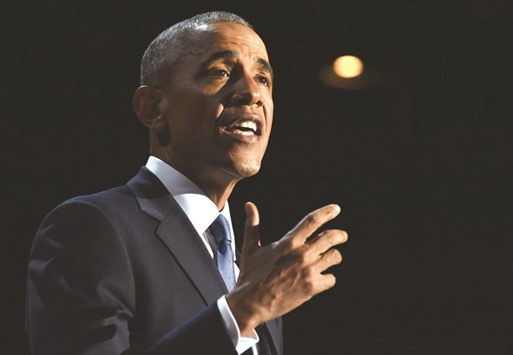
Obama: warning to incoming Trump administration