


The African Union (AU) will cease to recognise Yahya Jammeh as Gambia’s president as of January 19, the date he is due to hand power to the winner of the December election, the AU’s Peace and Security Council said yesterday.
Jammeh, whose authoritarian rule began with a 1994 coup, lost the December 1 election to Adama Barrow by a slim margin.
He initially conceded defeat but a week later contested the result and called for another poll.
He now refuses to give up power.
Whether Gambia can install Barrow as president is seen as a test for African democracy in a region accustomed to power changing hands at the barrel of a gun.
In a statement issued after a meeting in the Ethiopian capital, the council also warned of “serious consequences in the event that his action causes any crisis that could lead to political disorder, humanitarian and human rights disaster, including loss of innocent lives and destruction of properties”.
In the past, the AU has often talked tough but backed away from any action that might lead to further conflict.
However international pressure on Jammeh is growing.
A delegation of West African officials including Nigerian President Muhammadu Buhari, Liberian leader Ellen Johnson Sirleaf and Ghana’s President John Mahama arrived in the capital Banjul yesterday.
They will try to persuade Jammeh on behalf of regional bloc ECOWAS to make an honourable exit, rather than risk dragging the country into crisis or civil war.
“Only God knows whether Jammeh will accept to step down,” Buhari said.
While ECOWAS has voiced its commitment to seeking a peaceful solution to the impasse, it has also hinted at possible military action if Jammeh stays on beyond the end of his term next week.
“This talk is very, very crucial because it is on the basis of this talk that everybody can now begin to see which option to take,” said Nigerian Foreign Minister Geoffrey Onyeama, also part of the delegation.
Diplomats and the Gambian opposition are trying to persuade Jammeh that he would come to no harm if he stepped down.
Nigeria’s lower house on Thursday voted to offer Jammeh asylum.
The MPs said “the clock is ticking fast” for Gambia and there was a need to step up diplomacy, as the possibility of violence and mass displacement threatened West African stability.
Nigeria’s President Buhari should “extend Nigeria’s readiness to offer ... Jammeh safe haven in Nigeria to live securely as a way of ending the political stalemate”, they said.
There was no immediate response from Buhari.
Mai Ahmad Fatty, a senior member of Barrow’s coalition, said that Jammeh would be entitled to the usual benefits afforded past heads of state, including an office of his choosing, bodyguards and luxury vehicles.
He also sought to play down the possibility of legal action against Jammeh, whose rule has been marred by the imprisonment and torture of opponents, rights groups say.
Critics have called for his prosecution.
“If there are any crimes against President Jammeh, we cannot say so because the crimes must be proven in a court of law. But at the moment, we are not talking about that,” he said.
Meanwhile, a lawyer for Jammeh has filed an injunction asking the Supreme Court to bar Barrow from swearing in this month.
“Barrister Edward Gomez has filed an injunction asking the Supreme Court to grant order barring the swearing in of President-elect Adama Barrow. He filed this document few minutes close to 6pm,” a judicial source told AFP late on Thursday.
The lawyer asked the court to prevent Barrow’s planned inauguration for January 19 until the legal case had been settled, according to a document seen by AFP.
But Gambia’s chief Supreme Court justice said this week that the challenge could not be heard for several months as it did not have a full bench, and the extra judges needed to hear the case were not available.
Gambia relies on foreign judges, notably from Nigeria, to staff its courts due to a lack of trained professionals in the tiny West African state.
In response to the injunction request, Barrow’s office said in a statement that Jammeh could not exceed his five-year mandate, which expires on January 18.
“The winner should prepare for inauguration while the loser prepares for court. This is the fact that no Gambian should deny,” the statement said.
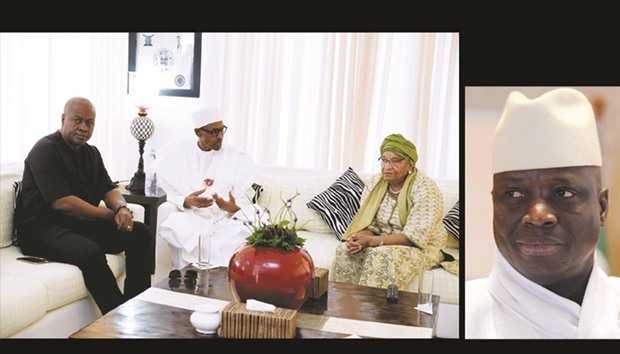
Nigeria’s President Buhari and Liberia’s President Johnson Sirleaf with Nigeria’s Foreign Affairs Minister Geoffrey Onyeama in Banjul yesterday. RIGHT: Jammeh: refuses to give up power after losing the December 1 polls.