


Thought the lira was due a breather after last year’s eye-watering losses? Think again.
Turkey’s political quagmire has been exacerbated by central bank inaction and higher-than-expected inflation to make the lira the worst-performing currency of 2017.
The currency has dropped 8.6% against the dollar in the year’s first eight trading days, adding to last year’s 17% slump. It’s set a new record on six of them. The pace of the depreciation has been so steep, it’s left all other major currencies trailing in its wake: The next worst-performer of 2017 has been Mexico’s peso, and it’s weakened about half as much.
There’s no shortage of ways to express the damage. But just why is the lira depreciating?
While the US Federal Reserve is in a tightening cycle, the Turkish central bank is dragging its feet. With the economy contracting for the first time in seven years in the most-recent data, the central bank, led by governor Murat Cetinkaya, is under pressure from politicians including President Recep Tayyip Erdogan to support growth. They’ve made statements the traders are reading as a commitment not to raise rates, setting up the lira as an easy short.
As developed-market yields rise, investors are demanding relatively higher returns to hold lira-denominated assets. Yet rather than raising rates to bolster the currency, the central bank slashed its top lending rate by a total of 250 basis points since March before raising its overnight lending rate by 25 basis points and the one-week repurchase rate by 50 points. Those were the only rate increases in three years during a period in which the lira depreciated on average about 15% a year. Last month the bank held rates steady even as the Fed’s rate increase added to pressure on the currency.
The currency’s weakness is fuelling inflation. Consumer price growth accelerated to 8.53% last month, more than 3.5 percentage points above the central bank’s target, the sixth year in a row that it’s been missed. UniCredit strategists expect inflation to climb to as high as 12% this year and are recommending investors hold off on buying local currency bonds.
Inflation is a problem for an economy that relies on foreign cash to finance a current-account deficit forecast to reach about 5% of gross domestic product this year. Rising prices deter foreign investors who fear the value of their assets will be eroded by inflation and a weaker currency.
Turks are going cold on the lira. On December 2, President Erdogan urged citizens to its defence: “Those with currency under the bed should come and turn their money to gold; they should come and turn their money into lira,” he said. Anyone who obeyed his call will have lost 6.6% of the value of their savings, but foreign-exchange deposits data suggests they’ve mostly ignored the call.
That’s not to mention Turkey’s indebted corporations, which have borrowed heavily in hard currency and now face ballooning foreign-exchange liabilities. The difference between the corporate sector’s foreign liabilities and assets climbed to a record $213bn as of September.
As the lira weakens those companies will clamour to buy dollars to service their debts - perhaps one reason why a central bank intervention on Tuesday that lowered banks’ required foreign-currency reserve ratios hasn’t sparked a recovery in the lira.
In an interview with Bloomberg on Tuesday, Economy Minister Nihat Zeybekci said the country is considering tighter restrictions on companies’ foreign borrowings.
After two separate nationwide elections in both 2014 and 2015, Turkey thwarted a bloody coup attempt last year. In 2015 it resumed a bombing campaign against separatists in the south-east, and suffered a series of terror attacks in major cities by both Kurdish and Islamic State militants. An hour into the start of 2017, an Islamic State gunman killed 39 people in an upscale, waterfront Istanbul night club.
Meanwhile, parliament voted in favour of debating changes to the constitution, a key step toward shifting executive authority from parliament to the office of President Erdogan. Even without those changes, the president has been concentrating power ever more firmly in his hands in recent years, a grip that’s tightened under the post-coup state of emergency.
Low liquidity isn’t helping either. Some of the sharpest moves in lira over the past seven trading days have taken place between the Tokyo-London hand-off, a sign that thin trading volumes are accentuating the currency’s decline. The head of Turkey’s banking regulator, Mehmet Ali Akben, on Monday said that there were “no big volumes” behind the currency’s plunge, and that it’s not yet at a level where it’ll hurt companies.
Those comments are typical of the nonchalant approach policy makers have taken as the currency crumbled. The central bank has held back from major intervention, and politicians have preferred to shift the blame to speculators who, they say, are attacking Turkey’s economy.
And all that is feeding into concern that when policy makers meet again on January 24 they’ll continue to resist the market’s call for higher rates.
Erdogan calls for ‘national mobilisation’ to defend lira
Reuters/Ankara/Istanbul
President Tayyip Erdogan accused Turkey’s enemies yesterday of using currency speculation to try to topple the state and urged the central bank to “thwart these games”, saying it had all the tools it needed after the lira plunged to record lows.
Erdogan repeated his call to Turks to sell foreign currency, urging a “sense of national mobilisation” against speculators.
He evoked last July’s military coup attempt, when people took to the streets to block tanks, and said anybody who helped the nation achieve its targets would be a hero.
“There is no difference in terms of goals between the terrorist with a gun in his hand and a terrorist with dollars and euros in his hands,” Erdogan said in a speech to local administrators at the presidential palace in Ankara. “The goal is to topple Turkey, to make it kneel and stray from its goals. They are using the foreign exchange rate as a weapon,” he said. “Of course, we have some problems, but none of these explain the exchange rate in our country.”
The lira has lost as much as 10% against the dollar since the start of 2017, making it the worst-performing major currency of the new year, as concern over political and economic stability is compounded by doubts about whether the authorities will take decisive steps to stabilise it.
It has also lost almost a quarter of its value in the six months since the failed coup attempt. Economists say the central bank needs to raise interest rates sharply to prevent further weakening.
But the bank is reluctant to make such an outright move, with Erdogan and the government pre-occupied by slowing economic growth and eager for lower borrowing costs to spur investment.
“It’s clear that the speculation on the forex rate has no depth....Our central bank and other banks must thwart these games. The central bank has the necessary tools and ability to take measures on this,” Erdogan said.
He also took aim at commercial lenders. Banks should not be involved in other calculations when the survival of the entire nation is on the line. I am also calling to the business world, it is time to invest and create jobs.”
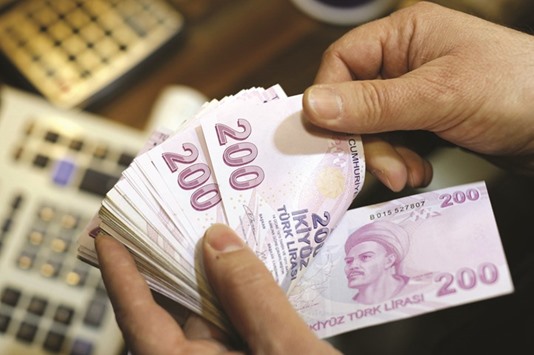
A money changer counts Turkish lira bills at a currency exchange office in Istanbul. The currency has dropped 8.6% against the dollar in the year’s first eight trading days, adding to last year’s 17% slump. It’s set a new record on six of them.