


China’s yuan strengthened against the dollar on Friday, but was on track for its biggest annual loss since 1994, which would make it the worst performing major Asian currency last year.
The yuan, which has reached an 8-1/2 year low, was on course to shed nearly 7% against the dollar in 2016.
Many market watchers expect the yuan to recoil further next year if President-elect Donald Trump’s policies stoke stronger US
economic growth and higher interest rates.
UK-based Fathom Consulting said if globalisation is thrown into reverse next year and China’s dependence on exports is laid bare, “its policymakers have little option but to quicken the pace at which they allow the renminbi (yuan) to appreciate.”
In 2016, the yuan has been pressured by worries about slowing Chinese economic growth and more recently by a resurgent US dollar, which has spurred capital outflows from many emerging markets.
Prior to the market opening on Friday, the People’s Bank of China set the yuan’s midpoint rate for the day’s trading at 6.9370 per dollar, much firmer than Thursday’s fix of 6.9497.
The stronger guidance rate came after a fall in the dollar on global markets.
A gauge of dollar strength against six other currencies fell to its weakest level in more than two weeks.
The figure stood at 102.47 after touching a low of 101.99.
On Friday, the spot yuan market opened at 6.9310 per dollar and settled at 6.9495, firmer than the previous late session close and 0.18% softer than the midpoint.
The yuan had lost 6.6% against the dollar on the year.
A trader at a foreign bank in Shanghai said trade was calm on the year’s last business day, but he saw more uncertainty ahead.
The yuan “may be more volatile next year” after changes to how a key index will be calculated, he said.
While moves would still mostly depend on changes in the US dollar, “newly-added currencies like the South Korean won will create some noise,” the trader predicted.
Late on Thursday, China announced a near-doubling of the number of foreign currencies in the basket used to set the yuan’s value.
The US dollar’s weight will be reduced to 22.4% from 26.4% and the euro’s to 16.34% from 21.39%, the China Foreign Exchange Trade System (CFETS) said.
Traders noted that authorities adopted a different approach towards the yuan at the end of last year. “The central bank was more inclined to release depreciation pressure on the yuan this time last year, when they loosened their grip on the spot rate and let the currency weaken to elevate the dollar purchase cost for those who want to swap yuan for dollars at the beginning of this year,” said one trader at a Chinese bank.”
But this time, authorities want to stabilise the currency as they are afraid of triggering stronger expectations of depreciation,” he said.
China’s authorities have rolled out policies over the past two months to tighten its grip on capital outflows after a slide in the yuan, which was down to hit 8-1/2 year lows.
The offshore yuan was trading 0.37% weaker than the onshore spot at 6.9755 per dollar.
Offshore one-year non-deliverable forwards contracts (NDFs), considered the best available proxy for forward-looking market expectations of the yuan’s value, traded at 7.3185, 5.21% weaker than the midpoint.
One-year NDFs are settled against the midpoint, not the spot rate.
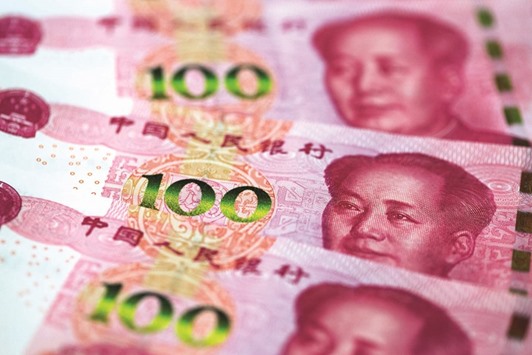
The yuan strengthened against the dollar on Friday, but was on track for its biggest annual loss since 1994, which would make it the worst performing major Asian currency last year