


Earlier this week, Qatar National Library (QNL) tweeted “Qatar’s oil exploration began in 1935 at the Dukhan field”, referring to an interesting analysis available on Qatar Digital Library (QDL).
A portal that is a result of partnership that started in 2012 between Qatar Foundation, British Library, and QNL, QDL is a free-for-all, bilingual (English and Arabic) digital information storehouse that covers modern history and culture of the Gulf and wider region, available online for the first time ever.
In a piece titled ‘The Qatar oil concession ushers in a new era for British relations with Doha’, Valentina Mirabella, Archival Specialist, British Library, explains how Qatar’s exploratory wells were drilled relatively late, although Major Frank Holmes sought an exploratory lease in 1922.
Considering that oil exploration had already begun in the 1920s, earlier in some cases – in most other countries in the Middle East – Qatar’s wells were explored relatively late. By that time, explorations had already concluded in Bahrain with the discovery of oil in 1931.
“Despite the discovery of oil in Iran at the beginning of the twentieth century, it was only in the 1920s that Britain’s interest in oil concessions deepened. In 1922, Major Frank Holmes, a British-New Zealander known as ‘the Father of Oil’, started seeking an exploratory lease in Qatar. A lease was granted by the Sheikh in 1926 to the British owned D’Arcy Exploration Company, a subsidiary of A.P.O.C. and early predecessor of British Petroleum (BP),” Mirabella writes in the piece posted on QDL.
“We can only speculate about what, if any, explorative moves were made to look for oil before this date. However, it is clear that A.P.O.C. agreed to undertake a geological exploration of the country in return for the sole right to submit an application for a concession,” she points out. “The importance of oil as a resource in Qatar only grew after the crisis of the pearling industry, which was partially brought about by the introduction of cultured pearls by the Japanese into the market. The fall in value of luxury goods after the Wall Street Crash of 1929 also played its role in realigning the Qatari economy towards oil.”
Exploration was carried out in early 1933 by two British geologists, E W Shaw and P T Cox, the piece says. The duo found that the rock composition of the highest hill in Qatar bore similarities with the rock found at the oil field discovered in Bahrain. The first license for exploration, granted in 1932, had to be extended for eight months until 1933.
“Then, finally after long negotiations, A.P.O.C. agreed the deal in 1935 by signing a seventy-five year oil concession. The negotiations were helped in no small part by the British offer of military protection … in exchange for exclusive rights to bid for the oil concession,” Mirabella writes.
After initial exploration was carried out to find out the right spot for drilling, oil was discovered onshore in 1939 at Jebel Dukhan, on the Southewestern coast of Qatar. In 1941, oil was also found in a second well, ten miles south of the first, which opened in 1939, the piece says.
However, the Second World War reset the priorities: in a letter dated January 14, 1940, which was sent to the Sheikh to congratulate him on the discovery of oil in Qatar, the Political Agent, Hugh Weightman, wrote: It is most regrettable that the Company’s operations are bound to be delayed by the war which has been forced on us by Hitler and the German Government. We must hope that victory will be speedily achieved so that normal conditions may return to the whole world.
“In December 1942, the camp at Dukhan was closed and the operations in Qatar were suspended. The British Government justified their decision with the Sheikh of Qatar on the basis of ‘the occurrence of force majeure’.
But the situation eventually changed. “Offshore exploration, drilling and extracting as well as the building of infrastructure only restarted in 1947. Between December 1947 and April 1948 a new geological survey was carried out in order to set up a new camp. Finally, in December 1949, oil exports began; an event that was to determine the beginning of a new era for Qatar,” Mirabella points out.
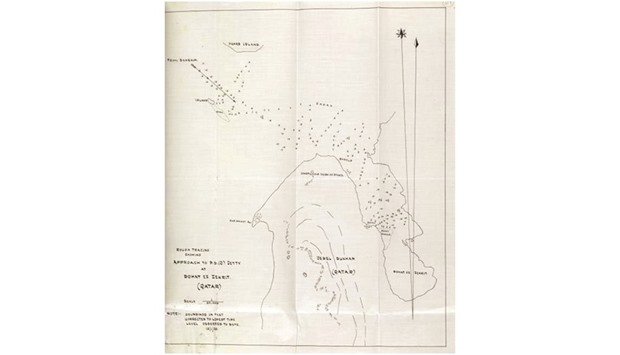
Rough tracing showing approach to the jetty at Dohat ez Zekrit, 1938.