


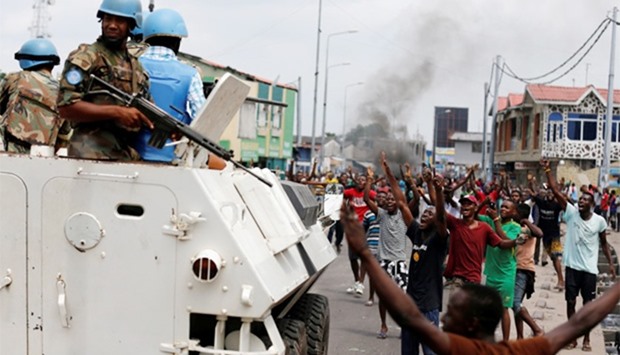
The were killed Tuesday as demonstrators clashed with police to protest President Joseph Kabila staying in power after his second mandate expired Monday at midnight, said Jose Maria Aranaz, UN human rights director for the central African country.
About 45 people were injured and at least 200 arrested, Aranaz said in Kinshasa.
He did not give figures for protests in the entire country. Human Rights Watch researcher Ida Sawyer tweeted earlier that 26 people had been killed in Kinshasa, Lumumbashi, Matadi and Boma.
Sporadic gunfire was heard in Kinshasa on Wednesday, though the city appeared generally calm.
Clashes between demonstrators and police were reported in the second-largest city Lumumbashi, while the pro-democracy group La Lucha said 18 of its activists had been arrested in Goma in the east.
Kabila would normally have relinquished power Monday at midnight, but the elections due in November were postponed to April 2018, citing logistical problems.
Most of the opposition regards the postponement as a ploy to allow Kabila to stay in power beyond the two terms allowed by the constitution.
Negotiations were due to restart Wednesday between the government and the main opposition parties, which reject a transitional government formed by the ruling coalition and smaller opposition parties.
The Congolese embassy in South Africa's administrative capital Pretoria meanwhile announced that it would close until next year after being stoned by Congolese demonstrators on Tuesday, the website Eyewitness News reported.
Several protesters were reportedly injured by rubber bullets fired by South African police.
Pope Francis renewed his earlier appeal to the Congolese, expressing hope that ‘in this delicate moment of their history, may they be artisans of reconciliation and peace.’ ‘May those who are in positions of political responsibility listen to the voice of their conscience, learn to see the cruel sufferings of their fellow citizens and have at heart the common good,’ the pontiff added.
Observers fear increasing unrest in Congo, which has been unstable since the fall of dictator Mobutu Sese Seko in 1997, with dozens of armed groups currently vying for power in the mineral-rich east of the country.