


Lloyds Banking Group agreed to buy Bank of America Corp’s MBNA credit-card business in the UK for £1.9bn ($2.4bn) in cash, marking its first major deal since being rescued by British taxpayers eight years ago.
The acquisition of MBNA, which has about £7bn of assets, will add £650mn a year to Lloyd’s revenue, equivalent to a 4% increase, according to a statement yesterday. As part of the deal, the London-based bank negotiated a £240mn cap on MBNA’s future payouts for the payment-protection insurance scandal.
“The MBNA brand and portfolio are a good fit with our existing card business,” Lloyds chief executive officer Antonio Horta-Osorio said. “The acquisition, funded through strong internal capital generation, increases our participation in the expanding UK credit card market with a multi-brand strategy.”
Lloyds executives have earmarked the bank’s credit card division for expansion as the business provides stable earnings combined with low operating costs. The acquisition of MBNA, which has an 11% slice of the UK market, will almost double Lloyds’s current share to about 26% and raises it into the same league as Barclays Plc, which controls about 27% of the market through Barclaycard. Lloyds said it will keep the MBNA brand separate from its own card offering.
The stock rose 0.8% to 63.05 pence at 8:32am in London, compared with a 0.1% average fall for banks on the UK’s FTSE 350 index.
“A deal would be a good use of excess capital and the terms of today’s announcement looks attractive,” Joseph Dickerson, an analyst at Jefferies International, said in an e-mail. “We estimate MBNA UK will lift the contribution of consumer finance business to 21% of group pretax earnings, up from the current 17%, thereby reducing reliance on UK mortgages.”
Lloyds hasn’t made a major acquisition since its ill-fated takeover of HBOS during the 2008 financial crisis left the bank in need of a bailout. The government still owns 6.9% of Lloyds after selling down its stake.
Whether the buyer would assume PPI liabilities was a key part of discussions, people familiar with the talks had said. MBNA had a 244mn-pound regulatory provision set aside for PPI redress as of the end of last year, according to its annual report. Lloyds has taken more than £17bn in charges for PPI claims over the past five years, more than any other major British lender.
The purchase is expected to complete by the end of the first half of next year. The bank forecasts an underlying return on investment of about 17% in the second full year after the acquisition and an improvement to the lender’s net interest margin of about 10 basis points a year. UBS Group AG advised Lloyds on the transaction.
The deal will use 0.8 percentage points of core equity Tier 1 capital, Lloyds said. The firm’s CET1 ratio was 13.4% at the end of September, and Horta-Osorio has pledged to return excess cash above 13% to shareholders.
Britain’s largest mortgage lender was up against private-equity firms including Cerberus Capital Management and Advent International in the MBNA bidding process, people familiar with the matter have said. About 1,700 people based in Chester, England, will join Lloyds as part of the transaction.
Bank of America bought MBNA in 2006 for $35bn. As borrower defaults rose and regulations reduced the industry’s prospects, it twice wrote down the card unit’s value, sold MBNA businesses in Canada and Ireland and folded the US business into its own operations. Some of the UK card assets were sold to Richard Branson’s Virgin Money Holdings UK in 2013.
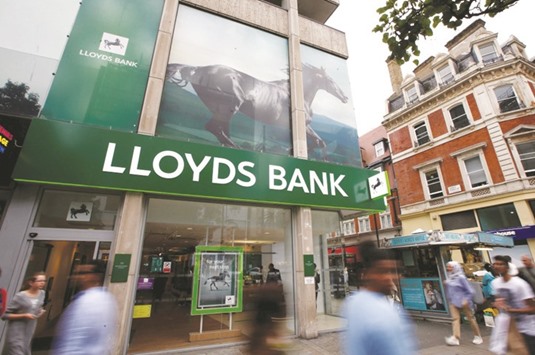
People walk past a Lloyds Bank branch on Oxford Street in London. The acquisition of Bank of America Corp’s MBNA credit-card business in the UK, which has about u00a37bn of assets, will add u00a3650mn a year to Lloyd’s revenue, equivalent to a 4% increase, according to a statement yesterday.