


Emerging equities slid to a one-month low yesterday but Turkey’s lira and dollar bonds recovered the losses they incurred on Monday after the Russian ambassador was killed in an attack in the Turkish capital Ankara.
The Turkish lira rebounded 0.7% against the dollar after slipping 0.7% on Monday when an off-duty policeman shot Russia’s ambassador to Turkey, Andrei Karlov, at an art gallery.
Turkish police have detained six people in connection with the killing. Both Russia and Turkey pledged the need for more efforts to “fight terrorism” after the shooting, with the Russian, Turkish and Iranian foreign ministers due to meet in Moscow to discuss the crisis in Syria.
“There is some relief there has not been an escalation of tensions, unlike what we saw last year with the downing of the Russian plane,” said Manik Narain, emerging FX strategist at UBS.
“In the medium term it could introduce some downside to expectations of a rebound in Russian tourism next year but for now markets see the risks as contained,” he said, adding that an easing in US Treasury yields had helped.
The yield premium paid by Turkish sovereign dollar bonds over US Treasuries on the JPMorgan EMBI Global Diversified index narrowed by 3 basis points (bps) to 365 bps after widening on Monday.
Stocks slipped a touch after closing down 0.5%.
The market is awaiting a decision on interest rates by the Turkish central bank.
A Reuters poll showed a majority of analysts expected a rate hike though some thought the bank might pause.
“It’s not entirely clear they perceive a need to tighten,” Narain said.”The central bank has not been incrementally tightening liquidity in recent weeks as the lira has weakened so there is a risk they don’t come up with a more hawkish intent.”
Russia’s rouble firmed 0.2% against the dollar after gaining 0.3% on Monday. Moscow-listed rouble stocks were up 0.25%, hovering below record highs hit earlier in December.
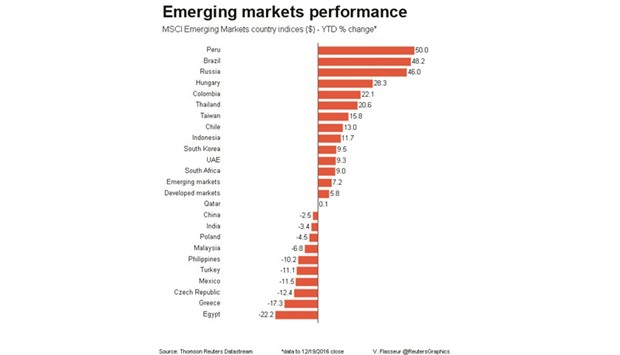
MSCI’s emerging equities index slipped 0.3% to one-month lows in its fifth straight day of losses.
Emerging assets have been hit by guidance from the US Federal Reserve that it will tighten faster than previously anticipated, with US President-elect Donald Trump’s expansionary policies expected to fuel inflation.
Asian markets led the selling, with Chinese stocks falling 0.5% after Beijing’s moves to tighten supervision of shadow banking activities. China’s yuan firmed but bonds remained weak with yields at a 15-month high.
Asian currencies suffered with Malaysia’s ringgit at its weakest level against the dollar since January 1998.
In emerging Europe Polish stocks rose over 1% to their highest level since April 2016, whilst the zloty firmed 0.2% against the euro.
Poland’s lower chamber of parliament has removed a temporary ban on access for the media after protests.
Hungary’s forint was steady and bonds firmed ahead of a central bank meeting at which rates are expected to remain on hold at 0.9%. It is possible the bank will announce a further cut in the three-month deposit facility.
Ukrainian dollar-denominated bonds rose across the curve after the International Monetary Fund pledged support following the government’s decision to nationalise PrivatBank.
.