


Deutsche Bank agreed to pay $37mn and admit to misleading customers about its dark pool stock-trading platforms to settle a joint state and federal probe, bringing the bank a step closer to resolving several potentially costly legal challenges in the US.
The bank will admit to violating state and federal securities laws over a two-year period by failing to address known technical problems with its proprietary dark-pool ranking model, the US Securities and Exchange Commission and New York Attorney General Eric Schneiderman said on Friday.
“Misleading and self-serving statements that defraud investors will not be tolerated,” Schneiderman said. “Electronic order routing systems that route investor orders to various markets, including dark pools, are a part of modern equities trading, and companies that promote their routing capabilities must do so truthfully.”
Despite Deutsche Bank chief executive officer John Cryan’s push in February to “speedily” resolve legal and regulatory matters, the Frankfurt-based lender continues to grapple with concerns that many of its global rivals have put behind them — including US probes into its mortgage-backed securities business and into whether its traders colluded to manipulate currency rates.
Deutsche Bank said in September that the US Justice Department had opened negotiations by seeking as much as $14bn to settle a probe tied to mortgage securities. That would be on top of the more than $9bn in fines and settlements it has paid since the start of 2008, according to data compiled by Bloomberg.
The bank is also being investigated by US and UK authorities over whether its internal controls failed to catch some $10bn in transactions that may have moved money out of Russia, people familiar with the matter have said.
Friday’s civil agreement extends a string of settlements in probes of whether banks properly disclosed how trades were executed or who was on the other side of them with the private platforms. In January, Barclays agreed to pay $70mn and Credit Suisse Group $84.3mn to settle allegations by the SEC and Schneiderman of wrongdoing in their dark pools. The settlements hinged on whether the banks adequately disclosed how their venue worked to their customers.
“Deutsche Bank is pleased to have resolved these matters,” the company said in a statement on Friday. “We believe that all concerns described in the settlements, which do not allege intentional wrongdoing or misconduct, have been remediated.”
The bank told clients for years that its ranking model for dark pools, an industry term for private stock trading platforms that compete with public exchanges, would periodically re-rank the pools based on their execution quality and available liquidity, according to the statement. In reality, the bank used stale rankings from 2012 to 2013, and failed to fully fix the problem during an attempted update to the system without telling clients, the attorney general said.
Deutsche Bank’s clients and potential clients were led to believe that its model was being regularly updated with “objective” data in order to reflect the current state of trading in the venues to which Deutsche Bank routed orders, so as to direct client orders to the most optimal venue.
From January 2012 to February 2014, technical problems at Deutsche Bank prevented the execution quality rankings from being performed, Schneiderman said in a statement. “Despite knowing about the problem for over a year, Deutsche Bank did not address the issue,” he said.
Deutsche Bank also manually overrode its dark-pool-ranking model to prioritize trading on its own venue after a coding error placed its platform in the lowest tier of the lineup. That move wasn’t disclosed to clients.
The same coding error also gave two other venues inflated rankings in its system. As a result, they received millions of orders that wouldn’t have been routed their way if the bank’s model worked as advertised.
The Financial Industry Regulatory Authority fined Deutsche Bank an additional $3.25mn on Friday for failing to provide accurate information in regulatory filings on the operation of its private trading venue.
FINRA said in a statement that the bank failed to provide the same information to all clients of its alternative trading systems about certain services and features. As a result, some customers including high-frequency trading firms received services that others may not have known were available.
US regulators have increased scrutiny of dark pools in recent years. The private trading platforms emerged in the 1980s as a way for institutional investors to trade large blocks of stock without tipping their hand to the rest of the market.
Other multimillion-dollar SEC settlements have included a $20.3mn accord with Investment Technology Group, which was alleged to have run a proprietary trading desk that used knowledge of customers’ requests to trade for its own benefit.
In January 2015, UBS Group was fined $14.4mn by the SEC for failing to provide adequate information about how its dark pool operated.
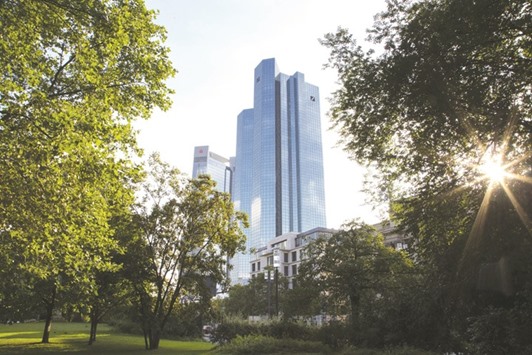
The twin tower skyscraper headquarter offices of Deutsche Bank in Frankfurt. The bank will admit to violating state and federal securities laws over a two-year period by failing to address known technical problems with its proprietary dark-pool ranking model, the US Securities and Exchange Commission and New York Attorney General Eric Schneiderman said.