


Unicredit plans to raise €13bn ($13.8bn) in a rights offer, betting that a balance-sheet cleanup and cost cuts will persuade investors that Italy’s biggest bank can restore profitability even without much revenue growth.
The bank is targeting €4.7bn of net profit in 2019 with a return on tangible equity above 9%, Milan-based Unicredit said in a presentation of its strategic plan yesterday. As part of the three-year strategy, the bank plans to shed an additional 6,500 jobs, bringing the total to 14,000, as it aims for €1.7bn of annual cost savings.
Unicredit chief executive officer Jean Pierre Mustier, a 55-year-old Frenchman, in July took the helm of a lender burdened by a mounting pile of bad loans, record-low interest rates and Italy’s longest recession since World War II. The bank had the slimmest capital buffer among those deemed important to the financial system in the latest European stress tests.
While the bank expects annual costs to drop, it sees revenue rising by just 0.6% per year through 2019. Unicredit sees falling net interest income, with growth coming from fees and commissions, it said in a presentation in London.
“With almost no revenue growth in the foreseeable future, the plan is focused on cutting costs and improving the asset quality and capital levels,” Luigi Tramontana, an analyst at Banca Akros, said in a note to clients. “The rights issue stands at the top of the expectations, given the stronger-than-expected effort” to boost loan-loss reserves.
Unicredit has struggled to build up capital, a task compounded by the bank’s complex structure after $60bn of acquisitions it made in the past decade under previous management. To simplify the bank and boost buffers, Mustier is disposing of assets including the Pioneer Investments fund management business and its Polish unit, Bank Pekao. It expects to raise about €8bn from those deals as well as the sale of its 30% stake in online lender FinecoBank.
“We are taking decisive actions to deal with our non-performing-exposure legacy issues to improve and support recurring future profitability,” Mustier said in the statement.
Unicredit will focus on organic growth and doesn’t plan further acquisitions, the CEO said at a press conference, ruling out acquisitions. The company’s German unit, formerly Hypovereinsbank, is a strategic asset in a country that is core to the bank, Mustier said, adding that he also isn’t looking to sell the company’s shipping business or other major operations.
The stock rose as much as 9.3% and was up 6.9% at €2.69 as of 11:37 a.m. in Milan. Unicredit has lost about half its value this year, valuing the bank at €15bn.
The capital increase will take place in the first quarter of next year, Mustier said on a conference call with journalists. The CEO said he’s confident Banca Monte dei Paschi di Siena’s efforts to raise capital will be resolved this month and will have “no impact” on his own bank’s fundraising.
The revamp will help Unicredit to increase its common equity Tier 1 ratio to more than 12.5% by 2019 from 10.8% at the end of September. The bank won’t pay a dividend for 2016 and targets a 20% to 50% payout ratio in subsequent years.
Part of the funds the bank is raising will cover losses from disposals of bad loans. Unicredit said it will set aside €8.1bn for non-performing loans as it plans to move €17.7bn of soured debt off its books for securitisation and a subsequent sale.
The bank said one-offs this quarter will total €12.2bn.
Fortress Investment Group and Pimco will take majority stakes in the two units that will take on the non-performing loans, Unicredit said.
“We welcome the focus on cleaning up the balance sheet, although some may have hoped the extent of provisions could have delivered a larger upfront non-performing loan reduction,” Jefferies Group LLC analysts including Benjie Creelan-Sandford said in a note, repeating their buy rating. “Given lack of control over the external environment, we think the focus on capital and costs is important.”
Banks across Italy are contending with expectations of low economic growth, pressure from European regulators to meet stricter capital standards and political instability following the fall of Matteo Renzi’s government. The prospect that Monte Paschi may need a state rescue if its capital plan fails has also affected confidence in Italian lenders across the board.
The €4.7bn profit target compares with a consensus of €3.9bn for 2019, according to the Jefferies analysts. On a comparable basis the bank made €1.5bn in 2015.
The bank’s €1bn of 6.75% additional Tier 1 bonds, the first notes to take losses in a crisis, rose 2.5 cents to about 92 cents, near a 2016 high, according to data compiled by Bloomberg. They fell to as low as 70 cents in February.
Regulators are pushing Italian lenders to clean up their balance sheets, strengthen capital buffers and cut an estimated €360bn in non-performing loans. Unicredit has sold more than €10bn of bad loans in the past three years and has set aside almost €25bn for loan-loss provisions since 2013.
Total net costs will drop to €10.6bn from €12.2bn in 2015, the bank said. The bank employed about 123,000 people at the end of September. Excluding businesses the bank is selling, headcount was 99,500 at the end of the third quarter, and will fall to 87,000 by 2019.
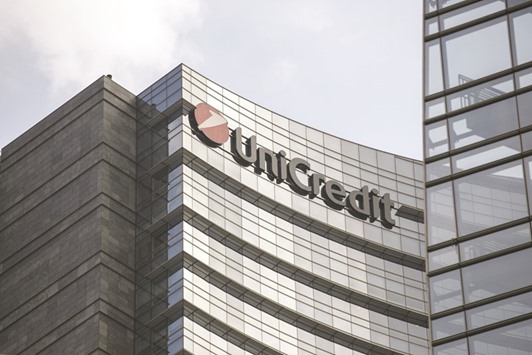
A logo is seen on the exterior of the Unicredit headquarters in Milan. The bank is targeting u20ac4.7bn of net profit in 2019 with a return on tangible equity above 9%, it said in a presentation of its strategic plan yesterday.