


Indices in London, Frankfurt and Paris pulled back after soaring last week when the European Central Bank decided to extend its massive quantitative easing (QE) stimulus to December 2017.
In London, the FTSE 100 down 0.9% to 6,890.42 points; Frankfurt — DAX 30 down 0.1% to 11,190.21 points; Paris — CAC 40 down 0.07% to 4,760.77 points and Milan — FTSE Mib up 0.4% to 18,370.32 points at the close yesterday.
World oil prices jumped yesterday after non-Opec producers struck a deal to cut output, while Europe’s main stock markets were subdued before a key Fed meeting this week.
At the same time, markets are on tenterhooks before a widely-expected interest rate hike from the US Federal Reserve.
“Markets are taking a breather after a strong run...and Fed risk this week,” City Index research director Kathleen Brooks told AFP.
“Oil is in focus, so too is central bank risk, but overall we think it is low (trading) volumes as markets wait for the Federal Reserve before piling back in — or not, depending on the outcome.”
Oil prices surged over two dollars per barrel for much of the day after 11 non-Opec countries agreed to huge cuts in crude production, while Opec kingpin Saudi Arabia also signalled a bigger reduction in output than previously agreed.
“It is a little surprising that investor sentiment is not more upbeat...given the latest leg higher in the oil price,” noted XTB analyst David Cheetham. “The main scheduled event that will be driving markets this week is the Fed meeting.”
There seems little room for doubt that the US central bank will raise the benchmark interest rate in the coming week for only the second time in a decade.
With unemployment at a nine-year low, jobs being created at an average of 180,000 per month, the economy growing at better than 3% in the most recent quarter and some signs of a pickup in inflation, the writing is on the wall.
The Dow held steady in opening trade yesterday, but the S&P 500 and Nasdaq Composite both retreated from record closes set on Friday.
Elsewhere, there is lingering uncertainty over the future of Italy’s troubled Monte dei Paschi di Siena (BMPS) bank.
“Speculation has continued to abound as to the fate of Italy’s oldest bank which is one of the best performers on reports that Italian authorities will bail out the bank to protect client savings, in the event it is unable to scrape together the private finance it needs to stay afloat by the end of this month,” said Michael Hewson, chief market analyst at CMC Markets.
BMPS shares jumped 3.7%, after having fallen 10.5% on Friday when the ECB said it wouldn’t give the bank an extension beyond the end of the month to put together a deal.
The plight of the world’s oldest bank has raised broader concerns over the eurozone’s third-largest economy.
Italy’s main stocks index pushed higher, with sentiment boosted after Paolo Gentiloni was Sunday named Italy’s new prime minister following Matteo Renzi’s recent resignation.
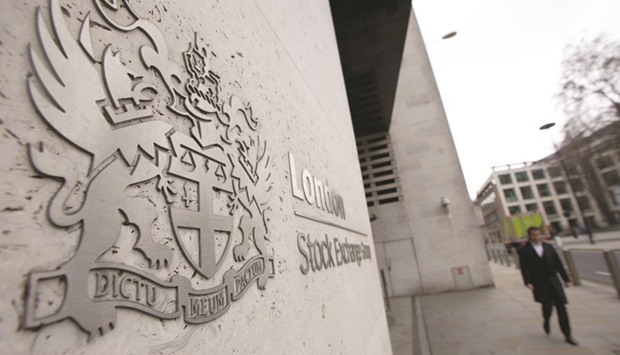
A pedestrian passes the London Stock Exchange headquarters. The FTSE 100 closed down 0.9% to 6,890.42 points yesterday.