


Cuba mourned its revolutionary leader Fidel Castro yesterday as it prepared a four-day funeral procession for the giant figure of modern history, loved by many but branded a tyrant by others.
After the stunned commotion triggered by Saturday’s announcement that Castro, 90, had died, yesterday was a day of preparations ahead of a flurry of events to mark his death.
Students left lighted candles next to a portrait of the black-bearded communist leader during a vigil at Havana University.
A titan of the 20th century who beat the odds to endure into the 21st, Castro died late Friday after surviving 11 US administrations and hundreds of assassination attempts. No cause of death was given.
“It is a great loss. The most important thing is that he died when he chose, not when all the counter-revolutionaries wanted,” said Carlos Manuel Obregon Rodriguez, a 43-year-old taxi driver in Havana. “It may not be painful for everyone, but it is for a lot of people. I was born under this revolution and I owe Fidel a lot.”
President Raul Castro said his older brother’s remains would be cremated Saturday, the first of nine days of national mourning. There was no official confirmation of whether that had yet happened.
Havana was unusually quiet after alcohol sales were restricted and shows and baseball matches suspended. No official events were held yesterday but a series of memorials will begin today, when Cubans are called to converge on Havana’s Revolution Square. “Today will be great. It will go down in history,” Obregon said.
Castro’s ashes will then go on a four-day island-wide procession before being buried in the southeastern city of Santiago on December 4, the government said.
Santiago, Cuba’s second city, was the scene of Castro’s ill-fated first attempt at revolution in 1953 — six years before he succeeded in ousting the US-backed dictator Fulgencio Batista.
Castro ruled Cuba from 1959 with an iron fist until he handed power to his brother Raul in 2006 due to his ailing health. Ordinary Cubans hailed him for providing free health and education. But he cracked down harshly on dissent, jailing and exiling opponents.
Even in retirement, Castro wielded influence behind the scenes and regularly penned diatribes against American “imperialism” in the state press.
Havana was unusually silent as the nine official days of mourning began. “What can I say? Fidel Castro was larger than life,” said a tearful Aurora Mendez, 82.
She recalled a life in poverty before Castro’s revolution in 1959. “Fidel was always first in everything, fighting for the downtrodden and the poor,” she said.
Indiana Valdes and her husband Maykel Duquesne, who work at a state-run bank, worried about life after Castro. “Fidel was the island’s protector, he was everywhere,” said Valdes, 43.
Fidel Castro, who came to power as a bearded, cigar-chomping 32-year-old, adopted the slogan “socialism or death” and kept his faith to the end.
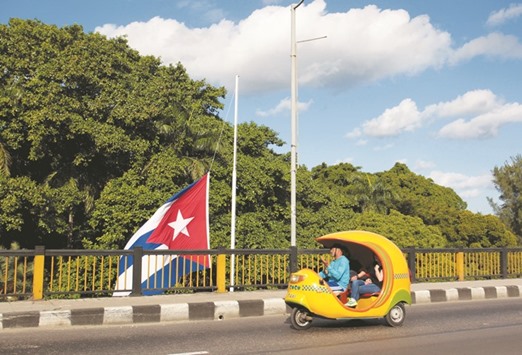
A coco-taxi drives past a Cuban flag at half mast in Havana, Cuba, yesterday.