


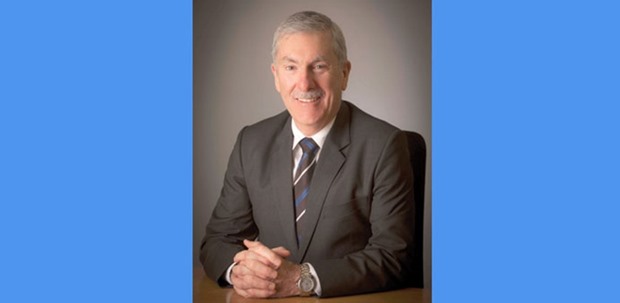

MOMENT TO CHERISH: Dr Ken Macleod, president of CNA-Q, second from right, with students. Photos by Adrian Haddad
Dr Ken Macleod has been fulfilling this responsibility at College of North Atlantic-Qatar (CNA-Q) for more than six years. The job comes with its challenges. As president of CNA-Q, he oversees an educational institution that has over 2,000 students enrolled in its multiple programmes.
Now in its 15th academic year, it has produced over 5,000 graduates with most of them Qatari nationals, who are now part of Qatar’s skilled workforce. Under Dr Macleod’s leadership, the college has initiated many new programmes tailored to the economy of Qatar, and aligned with the Qatar National Vision 2030.
He has seen the college’s research portfolio grow to incorporate more pressing needs of Qatar’s economy and CNA-Q preparing to offer its first ever degree programmes while maintaining its focus on applied learning.
“Qatar does not need another traditional university as there are a number of fabulous universities here. What they need is a fabulous institute of applied learning and they have that (in CNA-Q). We are going to take it to another level,” Dr Ken Macleod tells Community in an interview detailing his college’s accomplishments and future plans.
Highlighting CNA-Q’s role in supporting Qatar National Vision (2030) and the state’s strategic direction to educate and retain young Qataris, Dr Macleod stresses that the college’s philosophy has always been to prepare students to graduate into their career of choice.
“I think we have been able to turn our graduates into what we here refer to as job-ready. And in addition to be job-ready, I think they (graduates) are world-ready,” says the CNA-Q president, with a proud smile.
The State of Qatar, he says, is recognising that CNA-Q has a unique offering here not just in Qatar but in the entire GCC. He has just returned from a conference in Dubai and said he could tell that what is going on in CNA-Q in terms of technology in education and in their programmes is far above than what is happening in those places.
Dr Macleod believes CNA-Q is going to be leading the way and he thinks Qatar does recognise that.
Dr Macleod arrived in Qatar mid-August 2010 with the term starting mid-September. He got to work from the word go. There was no time even to adjust to the “cultural and weather shocks.” He credits his “fabulous leadership team” for making it easier for him.
“The work gets you accustomed very quickly. There was of course a lot to be done. I worked with our leadership team, established different management structures and, of course, the recruitment and getting the year started,” recalls Dr Macleod.
Over a period of seven years, he says they have made adjustments and shut down programmes that were not in demand. All their programmes however, are tailor-made to Qatar’s needs and not imported from Canada.
“We are a state college that is funded by the state so we have to be sure that we are wise with the state’s money,” observes CNA-Q president.
Besides engineering and health sciences programmes, he says, the Business (administration) programmes have witnessed a phenomenal growth, particularly in the speciality of Human Resources which has attracted a number of females.
Interestingly, the CNA-Q president says since the beginning the percentage of males and females students at the college has been 65 and 35. Some 15 years ago it was a first modern campus offering co-education.
And it has all along conformed to the 2030 Vision of transforming Qatar into a modern state while respecting Qatari and Islamic values, he adds.
In the early days, when HH Sheikha Moza bint Nasser established the college, Dr Macleod says, she insisted that campus be not one hundred percent Qatari but somewhere between 80-20; the reason being so that there was an international experience for Qatari students.
“That mixture changed over the years. We have over 30 nationalities at the college. Some 65 percent of our students’ body is Qatari and more than 30 percent comprises more than 30 nationalities. That really does give quite an international experience,” says the CNA-Q president.
Taking about 2030 Vision, Dr Macleod says it is all about moving from petroleum-based economy to a knowledge-based economy but it is not going to happen overnight. This is very much still an oil-based economy.
However, he says what people fail to realise is that an oil-based economy is very much a knowledge-based economy.
“Through the technology employed by the oil and gas sector over the years, Qatar is a hotbed of fabulous technology. All businesses and certainly all the industries here are very technological. That is what CNA-Q shines at. We are a technical college,” says Dr Macleod.
Technology, he adds, is at the root of their programmes. The other identity of the college is all about experiential learning and applied learning.
The college offers world-class laboratories and classrooms, where students learn the skills that they will use right after graduation. As a Canadian institution, their instructional staff are Canadian citizens who have real-world experience in the subjects they are teaching.
In terms of the college’s research portfolio, Dr Macleod says they do not want to do traditional research.
The college wants to do research that is applied. That has a product. For instance, he says, they have a very experienced researcher who has been doing research for Qatar Petroleum on corrosion (specifically targeting pipelines) for the last four years. Another researcher has focused on STEM (Science, Technology, Engineering and Mathematics).
“I have seen our reputation grow. Our goal is to raise the prestige of TVET (Technical Vocational Education and Training) and I think we have done that. We have taken it to one level and now we are taking to another level. That was a challenge for me and my team here,” acknowledges the head of the college.
Dr Macleod says their stakeholders have always recognised their accomplishments because the college graduates people who are job-ready.