


The larger struggle in India involves beating the odds to simply get off the blocks, and then soldiering on to reach a level from where you feel confident about taking a giant leap of faith into the unknown – the big, bad and manic world of professional sport
The history of Indian sport can be described as chequered at best, where beating one’s opponents has often proven the easier part. The larger struggle involves beating the odds to simply get off the blocks, and then soldiering on to reach a level from where one feels confident about taking a giant leap of faith into the unknown – the big, bad and manic world of professional sport.
Just cast a cursory glance at the annals of sport in India and such examples are not hard to find. In the case of women, the struggles are often multi-layered, with the lack of affordable facilities, age-old traditions, social taboos and even religion combining into a deadly mix that has scuttled the hopes of many an aspirant.
P T Usha, the athlete who put Indian women’s sport on the world map, was a frail child who constantly fell ill in the early years of her life. One of six siblings, her parents just about managed to put food on the table. And even though she was touted as someone with a potentially bright future while still in school, the lack of training facilities in her home state of Kerala during the 70s and 80s were a hindrance that would have broken the weak-willed.
Usha, however, was anything but that. She was determined to demolish all hurdles in her path and carve out her own destiny, which she did in a manner that is now the stuff of legend.
“I had to rise above the system,” she has said in many interviews after blazing a trail for Indian women in a long career that fetched her more than 100 medals at the international level.
Saina Nehwal and Sania Mirza, who reached the top of the world rankings in their respective fields, badminton and doubles tennis, come from financially much comfortable backgrounds but still had to surmount different, but equally daunting, obstacles.
Nehwal is now based in the southern city of Hyderabad but was born in Hisar in the state of Haryana which is notorious for its patriarchal social structure and its abominable corollary – female foeticide. This practice has skewed the sex ratio in the state to such an extent that there exist only 877 women per 1000 men.
In Nehwal’s case it helped that her parents were badminton players themselves and forward-looking, but it is also well known that not everyone in their extended family was pleased when she was born. Her grandmother even refused to look at the baby’s face for almost a month after her birth because she was eagerly awaiting the arrival of a grandson.
“I was really surprised when I was told that my grandmother did not come to see me till a month after my birth. I was born seven years after my only sister Chandranshu and my birth was a big disappointment for her,” Nehwal wrote in a magazine column six years ago.
She added that her ties with some of her relatives have not been ideal because of the issue of how women in the family should be treated.
“My uncles and other relatives are against encouraging girls in every aspect and that includes sports. I hardly interact with them. My parents are more open. They back me all the way,” she wrote.
Her parents’ perseverance and her hard work have paid off with the result that she is one of the most successful sportswomen in the country with several titles and even an Olympic bronze medal to boot. Though upstaged of late by her city mate P V Sindhu who won the badminton singles silver at the Rio Olympics this year, Nehwal still continues to hold her own in the highly competitive professional circuit.
Sania Mirza’s case is perhaps the most unique of all. Although she hails from a progressive Muslim family, her decision to take the plunge into the world of professional tennis was at once surprising as it was inspiring.
The very fact that a Muslim girl was aiming to make a mark for herself in a glamorous sport where beauty and sexiness are considered part and parcel of the package was considered somewhat of an oddity. While India has produced several legends in cinema – Madhubala, Nargis and Meena Kumari to name a few – a Muslim sportswoman and someone as successful as Mirza was a rarity.
She was an object of mystery at first, but when she started winning matches she became an instant hit with the Indian diaspora. Even in Doha, where tragically most sports are played in front of sparse crowds, Mirza single-handedly draws thousands of people to the Khalifa Tennis Complex whenever she makes an appearance. During the Doha Asian Games in 2006 an international news agency regularly referred to her as “Indian darling” in its reports as adoring fans packed the stadium cheering her every move.
Her success has led to unwanted situations a few times with controversy-chasing journalists queuing up to interview Muslim clerics in the hope of eliciting a sensational fatwa. Some of them were only too willing to oblige.
“The dress she wears on the tennis courts…leaves nothing to the imagination,” cleric Haseeb-ul-Hasan Siddiqui told a newspaper in 2005, a week after the 18-year-old Mirza had become the first Indian woman to make round four of a Grand Slam event, the US Open.
“She will undoubtedly be a corrupting influence,” he added, asking her to follow the example of Iranian women who wear track pants and headscarves while playing sports.
Yesterday, another 18-year-old Indian woman was scorching the Doha Golf Club in the Qatar Ladies Open, a Ladies European Tour (LET) event.
A couple of weeks ago, Bengaluru girl Aditi Ashok had become the first Indian to win an LET event, the Indian Open in New Delhi. Yesterday, she enhanced her growing legend with her second title on the trot, taking her earning to a whopping 125,000 euros from just two tournaments. The wiry 18-year-old had served notice at the Olympics where she was in the hunt for a medal for a while before dropping out of contention.
Unlike many of her compatriots, though, Aditi never had to grapple with lack of resources or taboos. She was intrigued by the game as a five-year-old while having breakfast with her parents at a restaurant at the Karnataka Golf Association and simply wandered onto the course to have a look. The rest, as they say, is history. But with a name that translates to “limitless”, this could be just the beginning.
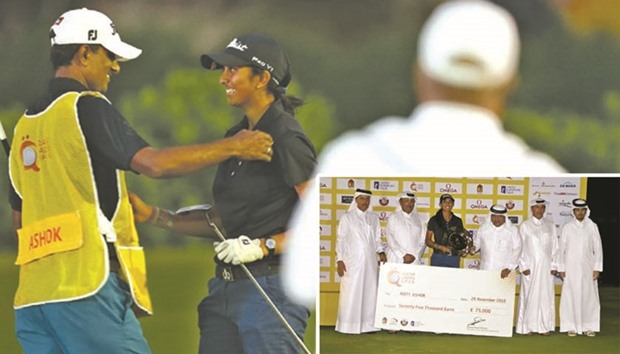
Well done sweetheart: Aditi’s father Ashok, who is also her caddie, congratulates her on her victory in the Qatar Ladies Open at the Doha Golf Club yesterday. Bottom right photo: Aditi Ashok poses with golf officials after her victory yesterday.