


As the oil market anxiously awaits Opec’s decision this week, some of the countries hardest hit by the biggest price crash in a generation may have found a lifeline outside of the group.
India, the world’s fastest growing crude consumer whose appetite for fossil fuels is forecast to surge in the next two decades, will likely decide next month on whether to advance $15bn to Nigeria for future supplies. Essar Oil Ltd, operator of India’s second-biggest refinery, has struck a $13bn deal which may lead to the plant processing more oil from Venezuela.
With prices languishing at under $50 a barrel, about 55% below its 2014 peak, smaller sellers have been the most vulnerable to falling revenues. Nigeria has been pushed to the brink of its first full-year economic contraction in 25 years, while Venezuela struggles to ward off a debt default at its national oil company. Now the two crude producers are finding their own means of survival as Opec seeks to resolve an impasse over output cuts aimed at stabilizing the market.
“Countries like Venezuela and Nigeria, reeling under financial crisis, will challenge any Opec decision that works against their economic interests,” said Kunal Agrawal, an analyst with Bloomberg Intelligence. “These countries want to secure long-term supply contracts with the likes of India and China.”
India, which imports more than two-thirds of its oil from the Middle East and whose demand is forecast to double through 2040 to 10.3mn bpd, is seeking to diversify its purchases to guard against the geopolitical risks tied to the world’s biggest suppliers like Saudi Arabia and Iraq. Over 80% of India’s crude is imported, and with a burgeoning population and an economy projected to grow 7.4% next year, companies such as the UK’s BP and Russia’s Rosneft are eyeing a piece of an oil retail market already worth $117bn.
Rosneft has indicated it intends to process crude from its share of oil fields in Venezuela at Essar’s refinery after the Russian company’s acquisition of the facility at Vadinar in western India. Nigerian Oil Minister Emmanuel Ibe Kachikwu said last month that the West African nation is looking to sign a pact with the Indian government for $15bn in advance payments for its oil in December.
“You can’t depend on one country, but you have a basket of countries from where you take,” said Mukesh Kumar Surana, chairman of India’s state-run refiner, Hindustan Petroleum Corp. “So there will be opportunities for smaller producers.”
Those deals are a welcome respite for Nigeria and Venezuela. Nigeria, which counts oil as its biggest foreign-exchange earner, could see its gross domestic product shrink 1.7% this year, according to the International Monetary Fund, its first full-year contraction since 1991. Venezuela has faced widespread shortages of food and essential products as the price of oil, which accounts for 95% of its foreign currency earnings, collapsed.
The Latin American nation’s state-owned oil company, Petroleos de Venezuela, has struggled with its finances this year after the price it receives for its exports has plummeted 63% from over $100 a barrel in 2014. PDVSA, as the company is known, said last month that creditors holding $2.8bn of bonds that come due over the next year agreed to extend maturities in a highly anticipated swap that will buy the company some time.
Its finances were thrown into doubt again this week, after JPMorgan Chase & Co said in a report that PDVSA hadn’t fully paid coupons on bonds due 2021, 2024 and 2035. PDVSA said it has paid what’s due on the 2021 and 2024 bonds and blamed the delay on an administrative problem at Citigroup Inc. The company’s president, Eulogio Del Pino, confirmed it was using a 30-day grace period for bonds due in 2035 without saying why.
As the Organisation of Petroleum Exporting Countries prepares to make a decision on November 30, oil has rebounded about 10% since the middle of this month amid signs of renewed diplomatic efforts to agree on an output cut.
Goldman Sachs Group Inc is now “tactically bullish” on the likelihood of an agreement, and expects oil prices in New York to average $55 a barrel during the first half of 2017, up from previous estimates of $45 and $50 for the first and second quarters.
But for now, India may be the oil sellers’ best hope. “We are a solvent buyer. Anyone who is in need of selling, we are in need of buying,” said Lalit Kumar Gupta, chief executive officer of Essar Oil. “Our growth is real.” -With assistance from Elisha Bala-Gbogbo, Saket Sundria, Nathan Crooks and Lucia Kassai.
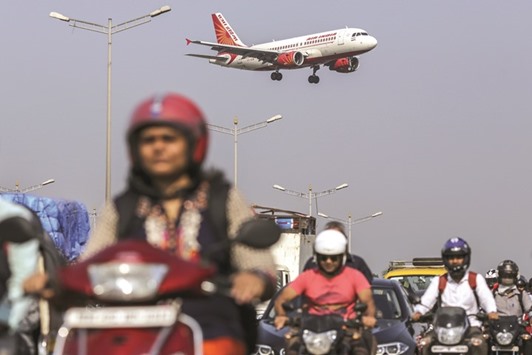
An Air India aircraft passes over traffic as it prepares to land at the Chhatrapati Shivaji International Airport in Mumbai. India, the world’s fastest growing crude consumer whose appetite for fossil fuels is forecast to surge in the next two decades, will likely decide next month on whether to advance $15bn to Nigeria for future supplies.