


Growth in leading eurozone economies slowed over the summer months and an expected German-led rebound at the end of the year may prove too short-lived for the European Central Bank to unwind its monetary stimulus.
Germany’s quarterly growth rate halved to 0.2% in the three months to September even though private consumption and state spending rose, as weak foreign trade slowed overall activity in Europe’s biggest economy.
Confirming a preliminary reading, the Federal Statistics Office said yesterday that net foreign trade subtracted 0.3 percentage points from GDP growth as exports fell 0.4% on the quarter and imports rose 0.2%.
State spending increased by 1.0% in July-September, contributing 0.2 percentage points to growth.
German authorities are spending billions of euros on accommodating and integrating more than one million migrants who have arrived since the start of 2015, many from war zones in Syria and Iraq.
Household spending rose by 0.4%, also adding 0.2 percentage points to growth, as consumers benefited from high employment, rising real wages and low borrowing costs.
“Many in Germany like to complain about Mario Draghi’s policy of low interest rates, but actually Germany in particular is benefiting from it,” VP Bank economist Thomas Gitzel said, adding that cheap loans were giving construction a push.
“Also thanks to Draghi, Finance Minister (Wolfgang) Schaeuble is managing the balancing act of increasing investment in public infrastructure without net new debt.”
Investment in construction edged up 0.3% in the third quarter while investment in plant and equipment fell by 0.6%, a sign that German firms are holding off investment. In an unusually downbeat report, the ECB said yesterday that political upheaval on both sides of the Atlantic is raising financial stability risk in the eurozone, which could increase concern about some countries’ ability to finance their debt.
Elections and referendums could fundamentally shift the political landscape, triggering sudden capital flows and market volatility, it warned.
Data for other eurozone countries pointed to a modest and fragile recovery in the 19-member currency bloc, driven mainly by domestic demand.
In Spain, the eurozone’s fourth biggest economy, growth slowed slightly to 0.7% in the third quarter from 0.8% in the April-June.
In France, the bloc’s No 2 economy, the central bank predicts growth to double to 0.4% in the final quarter from just 0.2% in the third.
Industrial morale there held steady in November for the third consecutive month. German business confidence also held steady at a high level in November, suggesting executives remain upbeat following Donald Trump’s victory in the US presidential election.
The United States is Germany’s most important trading partner and Trump’s protectionist rhetoric has unnerved many eurozone exporters — in addition to the uncertainty created by Britain’s June vote to leave the European Union.
The Munich-based Ifo economic institute’s business climate index was unchanged from 110.4 last month.
“The German economy seems to be unfazed by the election of Donald Trump as US president,” Ifo chief Clemens Fuest said.”Confidence in the German economy continues to be good.”
German companies were again more satisfied with their current business situation, but somewhat less optimistic regarding the coming months, the monthly survey showed. “If there is a ‘Trump effect’, it could show up later though — that’s what we saw after the Brexit vote,” Ifo economist Klaus Wohlrabe told Reuters.
Wohlrabe said Ifo’s business climate index suggested the German economy would expand by 0.5% in the fourth quarter, bringing full-year growth to 1.9%.
Another survey suggested German consumers are ready to splash out over the Christmas season and support growth in the final quarter.
Most economists see the third-quarter cooling as temporary, pointing to other sentiment surveys such as Markit’s purchasing manager index (PMI) that suggest a rebound in the final quarter.
Germany’s central bank said on Monday it expected manufacturing to drive a pick-up in growth in October-December.
“Since the first Brexit shock, the Ifo index has staged an impressive comeback, suggesting that the summer slowdown of the entire economy was only a blip and not a new trend,” ING-Diba economist Carsten Brzeski said.
But Brzeski warned that growth was “artificially” inflated by the ECB’s record-low interest rates and Berlin’s migration-related hike in state spending.
Capital Economics analyst Jack Allen said the Ifo index suggested the German economy was performing well in the fourth quarter, although “we expect growth to slow next year, putting pressure on the ECB to loosen policy further”.
The German government expects growth to slow to 1.4% in 2017, an election year, mainly due to sluggish foreign trade.
For the eurozone as a whole, economists polled by Reuters expect growth to hum along at a modest pace, helped by the ECB which is expected to announce that its asset purchase stimulus programme will be extended beyond March 2017.
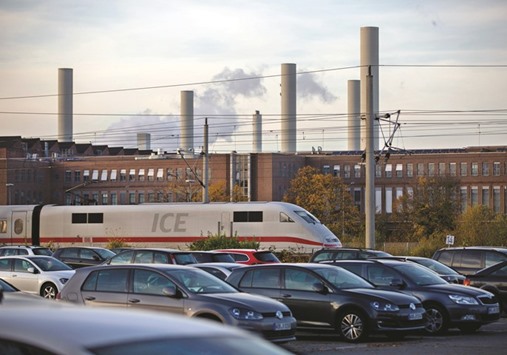
A Deutsche Bahn InterCity Express (ICE) train travels past the Volkswagen factory in Wolfsburg, Germany. The country’s quarterly growth rate halved to 0.2% in the three months to September even though private consumption and state spending rose, as weak foreign trade slowed overall activity in Europe’s biggest economy.