


A wax mask covered the face of Ferdinand Marcos for the 23 years his corpse was on show, but the body on display was no fake, the Philippine dictator’s mortician told AFP in an interview.
Frank Malabed, the embalmer of choice for high profile politicians and celebrities, revealed the secrets of his trade following the controversial burial at the Heroes’ Cemetery in Manila last week.
The interment stoked fresh speculation about the dictator’s final resting place, with many believing the real Marcos was secretly laid to rest years ago and the body on display had been a wax replica.
But Malabed, who embalmed the body, insisted it was real.
“The face the people saw was wax.
But for the rest of the body there was no need for that because it was clothed,” the 66-year-old told AFP.
“The hair, that’s only a wig.”
Marcos died in exile in Hawaii in 1989, three years after the “People Power” revolution forced him from office.
Critics say during 20 years in power he looted state coffers and ordered the torture and killing of thousands of foes.
Marcos’s body was embalmed by Malabed in Hawaii.
In 1993 it was flown to the ancestral home in the northern Philippines, where it was put in a glass case for public viewing.
Malabed said Marcos, who died from lung, kidney and liver complications aged 72, was disfigured by oedema – the build-up of fluid that causes tissues to become swollen.
Embalming drains blood and other body fluid, which is replaced with preservative solution.
But the resulting “shrivelled skin did not look good”, the mortician said.
“Ma’am did not care for that,” he added, referring to the widow Imelda.
“She wanted Filipinos to see president Marcos (the way) he looked before, when he was still young.”
Malabed said he received the already embalmed body a week after Marcos’s death, but had to repeat the procedure because the face looked “bloated” and he feared it would decompose within a week.
“I’m a perfectionist when speaking about embalming,” he said, later telling the Marcos family the reworked body would be intact for 30 years.
“I’m proud, because he was a 20-year president and not an ordinary person.”
In 1991, Malabed said the widow paid another mortician to work on the face with materials “similar to” the restorative wax used to rebuild the faces of people disfigured in fatal accidents.
Malabed said he last checked the corpse “by hand” on August 8, pronouncing it in good condition as burial preparations began in secret.
He said another mortuary handled the actual ceremony.
The dictator’s eldest daughter Imee, the family’s official spokeswoman for the body, did not respond to AFP’s requests for comment.
But days before the burial, Imee told ABS-CBN television that “of course” the body was real, though “all kinds of procedures, all kinds of chemicals had been used” on it.
As a child, Malabed dreamed of becoming an engineer, but he soon followed in the footsteps of his mortician father.
By the time he was an 18-year-old apprentice, Malabed was working on the mangled bodies of US soldiers killed in the Vietnam War, which had been flown to the then-US air base at Clark.
Malabed got his first big break embalming a brother and a sister of Imelda, a job which opened doors to the Marcos family. But it has not been all Marcos: he also embalmed Benigno Ninoy Aquino, the Marcos family’s arch-political foe whose assassination at Manila airport by government forces in 1983 altered the course of Philippine history.
Under strict instructions from the family matriarch, Malabed preserved the body, but made no effort to fix the bullet-shattered face.
Aquino’s corpse – wearing the same bloodstained jacket in which he had died – became the rallying point for the revolution that ultimately brought his widow to power, and sent Marcos into exile.
For Malabed, a devout Catholic, the identity of a person when they were alive is not important; he treats all his clients equally.
His skills do not come cheap, he admits, but says the final result is well worth it.
“I make people beautiful even in death.”
Marcos’ embalmed body was returned to his ancestral home where it lay on display for over two decades.
His burial in Heroes’ Cemetery last week sparked controversy in the Philippines, and removed him from the relatively exclusive global club of famous bodies on display.
Here are some of the others:
Vladimir Lenin Russian revolutionary Vladimir Lenin was the original communist leader to be embalmed, starting a trend among hard-left regimes around the world.
Lenin died in 1924 aged 53, and had wanted to be buried with his mother in the former imperial capital of Saint Petersburg, but was instead preserved in a mausoleum on Red Square, where he remains, attracting visitors curious to see the Bolshevik founder of the Soviet Union.
Debates on whether to remove the body started after the collapse of the USSR in 1991 but Russia’s Communist party has vehemently lobbied to keep Lenin in situ.
Egyptian mummies Say “Ancient Egypt” to any schoolchild and the first thing they’ll think of is the mummies – preserved remains of important figures.
The British Museum in London houses a collection of 120 human mummies from Egypt and Sudan, which count as one of its biggest draws for many visitors.
The museum also has 300 mummified animals, including dogs, cats and even a crocodile.
None of the mummies has been unwrapped since the 1790s and museum experts have used x-rays and CT scans to carry out research on them.
Mao Zedong The Chinese revolutionary leader, who died on September 9, 1976, has been embalmed and on show since 1977 in a glass cubicle in the Mao Zedong Memorial Hall in Beijing’s Tiananmen Square.
Mao’s body was placed in formaldehyde and other preserving fluids, according to an account in the People’s Daily newspaper, and today the parts of Mao’s body which cannot be seen are bathed in liquid.
When the mausoleum is closed, the cadaver is lowered into a container maintained at a low temperature, the paper said.
Eva Peron, Argentina’s emblematic first lady of the 1940s and 50s, was embalmed when she died of cancer in 1952 at age 33.
“Evita” was as adored by her husband’s poor and working-class base as she was reviled by the military and elite.
After Juan Peron was toppled in a 1955 coup, army officers secretly removed Evita’s corpse from its resting place at a pro-Peron trade union headquarters and hid it.
Worried Peronist militants would find it, then-dictator Pedro Aramburu had the body taken to Italy and buried in Milan under a false name.
Peron’s third wife and successor, Isabel, finally struck a deal: Evita’s body was returned to Argentina in 1974 and she has rested ever since in her family mausoleum in Buenos Aires, a place of pilgrimage for her admirers and fans of the musical and movie about her life.
Ho Chi Minh Although he wanted his ashes to be scattered over the country, the father of modern Vietnam was embalmed upon his death on September 2, 1969.
His body, preserved in the cold under a glass sarcophagus, has been on show since 1975 in a mausoleum in Hanoi.
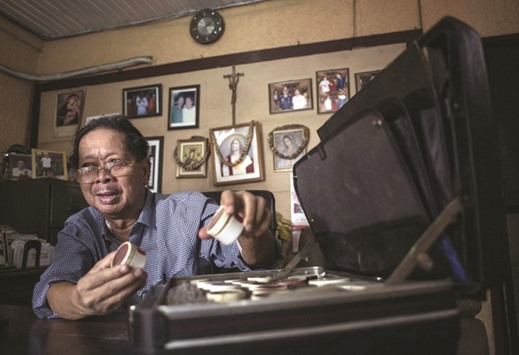
Frank Malabed, the embalmer of Ferdinand Marcos, shows the make-up kit that he uses for his job.